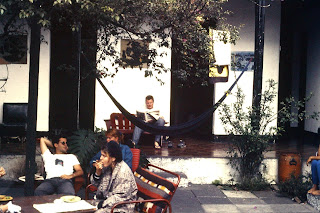
Friday, January 7, 2022

Antigua Guatemala

Thursday 7th January 1988

We had breakfast and checked out of the hotel for the walk to the Antigua Guatemala Bus Depot. It was a hot sunny day, and the Guatemalans were out shopping. The brightly coloured buses were waiting on the corner of Avenida 4 and Calle 15.

Surprisingly, the bus was only half full when it left. We went through heavy traffic through the extensive suburbs of Guate (Guatemala City). All the shops and workshops were gaily painted with pictures of their wares or services depicted on their walls.

The bus raced hairily along a well-tarmacked dual carriageway, challenging inertia on each sweeping bend. After fifty minutes we descended into Antigua Guatemala, luckily being forced to do so slowly due to “sleeping policemen” speed bumps in the road. Then it was on to the bumpy cobbled streets of the old capital city.

Antigua Guatemala, commonly referred to as just Antigua or la Antigua, is a city in the central highlands of Guatemala known for its preserved Spanish Baroque-influenced architecture as well as a number of ruins of colonial churches. It served as the capital of the Kingdom of Guatemala. It has been designated a UNESCO World Heritage site.

Antigua Guatemala serves as the municipal seat for the surrounding municipality of the same name. It also serves as the departmental capital of Sacatepéquez Department. Antigua Guatemala means "Old Guatemala" and was the third capital of Guatemala. The city was laid out in a square pattern, with streets running north to south and from east to west, with a central square.

Both church and government buildings were designated important places around the central plaza. The first building of a cathedral was begun in 1545 with the debris brought from the destroyed settlement in the valley of Almolonga; however, its construction was hampered by frequent earthquakes throughout the years.

Antigua was the capital of Guatemala until the city was almost completely destroyed by an earthquake in 1773 and the capital was moved to its current location, Guatemala City.

We got off at the main market and headed for the Hotel Placido on the Calle de San Sebastian. It looked expensive but a double room was only Q6.40 Guatemalan Quetzals. It had a delightful central garden and included free use of the kitchen, hot showers and a friendly family running it.

We went down to the market and spent an enjoyable time browsing through the blankets and leather work of the local indigenous Indians. We then bought an assortment of fresh fruit, which was so cheap that it was practically free, from squatting Indian women and went back to the hotel to prepare a fruit salad.

We got stitched up with the watermelon, which was unripe, but the rest was fine, especially the pineapple. We then went down to the green zocalo (town square) and basked in the sun before getting our hair cut, costing Q3 Guatemalan Quetzals each.

It is a very relaxed town with a mixture of tourists and travellers, mainly American, and the indigenous Indians. The huge Agua Volcano dominates the skyline to the south. The Volcán de Agua (also known as Hunahpú by Maya) is a stratovolcano located in the departments of Sacatepéquez and Escuintla in Guatemala. They do like a stratovolcano in Guatemala!

At 3,760 m (12,340 ft), Agua Volcano towers more than 3,500 m (11,500 ft) above the Pacific coastal plain to the south and 2,000 m (6,600 ft) above the Guatemalan Highlands to the north. It dominates the local landscape except when hidden by cloud cover. The volcano is within 5 to 10 km (3.1 to 6.2 miles) of the city of Antigua Guatemala and several other large towns situated on its northern apron.

The volcano was active in the late Pleistocene between 80,000 and 10,000 years ago but has not erupted since then. The local Kaqchikel people have always called this volcano Hunapú "place of flowers" or Jun Ajpu' "one hunter" (The calendar date for the sacred site; a typical method for naming sacred sites in Mayan cosmovision) in current Kaqchikel orthography.

The Spanish conquistadors also called it Hunapú until a lahar from the volcano on 10th September 1541 destroyed the original capital of Guatemala (now known as Ciudad Vieja) and the city was moved to the current site of Antigua Guatemala following this disaster. A lahar is a violent type of mudflow or debris flow composed of a slurry of pyroclastic material, rocky debris and water. The material flows down from a volcano, typically along a river valley.

In the evening we went out and failed to locate any of the bars that were recommended in our guidebooks. We had an average meal in an Italian restaurant and went to the Jardin Bar on the west side of the zocalo. Here we met Kevin from Hackney in London, Ann with an eye drawn on the cotton wool pad sellotaped over her infected real eye and an assortment of other Brits and Europeans who were studying Spanish at the Central Linguistic School of Antigua.

The night developed into a drunken debauch. We drank beer in the Jardin Bar then moved on to Mio Cid’s where they had music and Cuba Libres for Q1.25 Guatemalan Quetzals. A Cuba Libre is a classic Cuban cocktail of rum, cola, lime and ice. The bar was named after El Cantar de Mio Cid, literally "The Song of my Cid " (or El Poema de mio Cid), also known in English as The Poem of the Cid. It is the oldest preserved Castilian epic poem (Spanish: epopeya). Based on a true story, it tells of the Castilian hero El Cid, and takes place during the Reconquista, or reconquest of Spain from the Moors.

We ran out of money at about 19:30 hrs. but I delved into my emergency cash supply and managed to change $20 American Dollars into Guatemalan Quetzals to continue the nights merriment. We went briefly to another bar, but it was too expensive, and we returned to Mio Cid’s.

Towards the end of the night (at about 01:00 hrs!) we talked to a Spanish teacher who agreed to give us private lessons in our hotel for Q4 Guatemalan Quetzals an hour. We got a lot of information from other Westerners about the schools and staying with local families for immersion learning of Spanish.

Most of the other students were seldom with the families but spent most of their time on the piss (out drinking and revelling), especially the Australian girls that we met. Antigua Guatemala was a party town. Just before we left Declan upset the Commie contingent, who were going to Nicaragua to do voluntary work for “the cause”, by saying that Margaret Thatcher was an O.K. Prime Minister in Britain. A good time was had by all, and we returned to our beds in the early hours of Friday morning.

Thursday, January 6, 2022

Palacio Verde

Wednesday 6th January 1988

An extremely skinny lady was tending to her 2-day old baby in a hammock as we went out in search of “El Siglo Laundromat” (Lavandería El Siglo) which we were told was just around the corner on 6A Avenida. We had breakfast while our clothes were washing. It was a great morale boost to have clean, dry clothes to wear again.

It was a hot sunny day at last and we spent the rest of the morning in search of an illusive bookshop selling English books. Again, we got lost. We walked past the Presidential Palace which was heavily guarded by troops in camouflaged uniforms as well as regular Police clad in blue. A trooper with a heavy machine gun looked down on us from a neighbouring rooftop.

In celebration of the first century of independence in 1919, President Manuel Estrada Cabrera placed the first stone for a future palace next to the Plaza de Armas. The Italian architect Guido Albani was charged with designing the palace, but it never came to pass due to the collapse of the government soon thereafter.

Two years later, in 1921, President Carlos Herrera, with the Centenary very close, ordered the Palacio del Centenario to be built in only three months time with a small budget and few resources. It became popularly known as the Palacio de Cartón (Cardboard Palace). However, in 1925 it was destroyed by a fire.

In 1927 President Lazaro Chacón declared a contest for the design of a new palace. The contest was won by the artist Agustín Iriarte, but this project again never came to be. Finally, in 1932, President General Jorge Ubico published the basis for the design and construction of the palace, and on July 4, 1937, the first stone was placed. The National Palace was built between January 1939 and 1943. On November 10 of that year, the birthday of President Ubico, the present-day Palace was opened.

Known as Palacio Nacional de la Cultura (National Palace of Culture) also known colloquially as "Palacio Verde", it is identified as Guatemala City's symbol in its architectural context. It was the most important building in Guatemala and was the headquarters of the President of Guatemala. The building is the origin of all the roads in the Republic and has a spot known as Kilometro Cero (Zero Kilometre). It is now actually a museum and is also used for important acts of the government.

We gave up looking for the bookshop and I went off to the Post Office. The impressive Guatemala Post Office Building is the management centre of postal services in Guatemala. It was constructed between 1937 and 1940. The characteristic archway of the building was inspired by the Santa Catalina Arch in Antigua Guatemala.

Basically, it was a maze of rooms in a huge old building, each with a different function or service. I eventually found the small kiosk which sold postage stamps and was able to dispatch my cards and letters.

There are 100 centavos to a Guatemalan Quetzal and there were 5 x 7 centavo stamps for each postcard. Luckily, from past experience I knew to leave plenty of space for stamps when writing the address on a postcard. However, it was still difficult to get seven stamps on without obscuring the address or any of the writing.

Back at the hotel we sat in the sun in the garden and pored over our guidebooks, the South American Handbook and Lonely Planet. Out on the streets there is a strange mixture of expensive consumer good shops, pavement stalls, and small-time pedlars and beggars. The exhaust fumes from passing buses is black and choking.

We spent the afternoon in the cinema after a surprising free snack of soup and a piece of chicken opposite the Colon Cinema on Avenida 12/Calle 7. The first film that we saw was “Beverly Hills Cop” rather than “Beverly Hills Cop II” as advertised outside. The soundtrack was atrocious, so it was lucky that we had both seen it before.

In “Beverly Hills Cop” (1984) a freewheeling Detroit cop, played by wisecracking Eddie Murphy, pursuing a murder investigation finds himself dealing with the very different culture of Beverly Hills.

Likewise, with the second movie, “The Untouchables” which I had also seen before and Declan was able to pick up enough to enjoy it. In “The Untouchables” is a 1987 American crime film directed by Brian De Palma, produced by Art Linson, written by David Mamet, and based on the book of the same name (1957).

The film stars Kevin Costner, Charles Martin Smith, Andy García, Robert De Niro, and Sean Connery. During the era of Prohibition in the United States, Federal Agent Eliot Ness sets out to stop ruthless Chicago gangster Al Capone and, because of rampant corruption, assembles a small, hand-picked team to help him.

From the cinema we went to Ruby’s for a huge chicken Chow Mein and Monte Carlo beer. A review I found online says “Monte Carlo from Guatamala City is pale and fizzy with little to recommend it. The watery beer has a flavour profile reminiscent of damp wall board and unlit charcoal. Guzzled directly from a very cold ice chest, it could get the job done of slaking a sweaty thirst. But let this beer warm up even just a bit and you will be sorry.” We found it O.K.

The streets were virtually deserted when we returned to our lodgings at 21:00 hrs. Before going to bed we sat outside in a hammock for an hour or so and I finished off a quarter of a litre of a mysterious white spirit with coke.

I doubt that it was Zacapa Centenario rum which is an expensive premium rum produced in Guatemala by Rum Creation and Products, a subsidiary of Industrias Licoreras de Guatemala, and distributed and marketed by Diageo. It was created in 1976 to celebrate the hundredth anniversary of the foundation of Zacapa, a town in eastern Guatemala. It was the result of the blending, stabilization, and maturing processes of long-aged rums by doctor and chemist named Alejandro Burgaleta.

It could have been Guaro which is a favourite liquor distilled from sugar cane. Guaro is fiery with a slightly sweet taste and can be served as a shot or in a cocktail. Or Quetzalteca, which is an aguardiente, which means it's between 29 percent and 60 percent alcohol by volume. This potent raw cane liquor is great when mixed with juice but can also be drunk as a shot. Varieties include Quetzalteca Rosa de Jamaica, a strong yet sweet pink moonshine, and Quetzalteca Especial, a grape-style drink.

Declan preferred to sit and smoke wacky baccy.

Wednesday, January 5, 2022

Guate

Above: Livingston in Guatemala.

Tuesday 5th January 1988

The alarm clock squealed at 04:00 hrs., thanks to the new battery, and we packed up and stumbled into the gloom. We bought a ticket for the boat at a wooden hut, which cost us one Guatemalan Quetzal each, and we boarded the boat just as the heavens opened.

Luckily, it was a fair-sized boat, and the deck was covered. All available deck space was taken up with people and luggage. We bobbed along, standing uncomfortably for an hour and a half, arriving at the jetty in Puerto Barrios at dawn.

It was still pissing down, and we sploshed along the main street to the Bus Station. A bus was just about to leave so I washed down my antimalaria pills with Coca Cola and we jumped aboard the 06:45 hrs. to Guatemala City at a cost of 8.50 Guatemalan Quetzals each).

Guatemala City, locally known as Guatemala or Guate, officially Ciudad de Guatemala is the capital and largest city of Guatemala, and the most populous urban area in Central America. The city is located in the south-central part of the country, nestled in a mountain valley called Valle de la Ermita (English: Hermitage Valley).

Guatemala City is the site of the Mayan city of Kaminaljuyu, founded around 1500 BC. Following the Spanish conquest, a new town was established, and in 1776 it was made capital of the Kingdom of Guatemala.

In 1821, Guatemala City was the scene of the declaration of independence of Central America from Spain, after which it became the capital of the newly established United Provinces of Central America (later the Federal Republic of Central America).

In 1847, Guatemala declared itself an independent republic, with Guatemala City as its capital. The city was almost completely destroyed by the 1917–1918 earthquakes. Reconstructions following the earthquakes have resulted in a more modern architectural landscape. Today, Guatemala City is the political, cultural, and economic centre of Guatemala.

The coach was very comfortable and half empty. We drove through a very green and sodden landscape, much of it looking like the English countryside, except for the odd palm tree. The buildings were still single storey but much sturdier in construction than any that we had seen so far.

After a few hours the rain stopped, and we began to climb into the mountains. The road improved and the terrain became browner and more arid than green. The driver continued to cheerfully overtake other vehicles on blind hills and bends, but we got to Guatemala City at about 13:00 hrs.

We jumped off at the city centre, with me nearly forgetting my sports bag and leaving it on the bus. A quick walk around the town showed it to be quite modern and apparently affluent, with familiar Western brand names on electrically illuminated signs spanning the road.

There was a huge central zocalo surrounded by an arched canopy walkway, under which small stalls sold magazines, bags and digital watches as well as stranger items, such as liquidizer/blender spare parts.

We booked in at the Pension Meza which was recommended in the Lonely Planet guidebook. We opted for our own room with a double bed rather than a shared room with another person. It cost us Q8.80 Guatemalan Quetzals for a room overlooking a nice garden with places to sit and read or write. A native Indian woman wove coloured fabric outside our room while her children played in a hammock.

In the afternoon I went for a walk around the block to try and buy some postcards and got lost despite the simple road numbering system. Roads running from east to west were avenidas (avenues) and those running from north to south were calles (roads or streets).

The map was a simple criss-cross grid pattern with systematic numbering. When I eventually found my way back, postcard-less, we played ping pong (table tennis) and read our books until the evening.

At 18:00 hrs. we donned warmer clothing and set off in search of the ubiquitous Chinese Restaurant. All the electric signs across the streets were illuminated like a Hong Kong street scene at night and all the shops were open.

We passed the Post Office where all the postcards were on sale at stalls out front. We also spotted a McDonalds! We went into Ruby’s for a Comida China, a huge and excellent meal with beer for Q11 Guatemalan Quetzals.

Back at the hotel we retired early at 21:30 hrs., mainly through boredom. Even the hippy freaks that littered the patio at Pension Meza during the day had disappeared. At times it appears like a lunatic asylum here.

I tried to get a beer next door, but the bar was closed. Bizarrely, as we got into our sleeping bags, loud punk rock music began playing in the deserted lobby.

Tuesday, January 4, 2022

Africa Place

Monday 4th January 1988

It pissed down with rain all morning, so we nipped out to the nearest restaurant for breakfast. We had good scrambled egg served with doughnut-like bread and the dreaded frijoles (refried beans). A Swiss guy told us that it was a good idea to learn Spanish in Antigua Guatemala and recommended a school which offered lessons and immersion with Spanish-speaking families.

We visited the Post Office and sent a letter to Punta Gorda Police Station explaining how we were ripped off yesterday. We never heard anything further about this issue.

Soon we had to seek refuge from the torrential rain and we went back to the Hotel Caribe where we were staying, where the clouds hung low over the river. Pelicans and other huge birds sat in the palm trees looking dejected while the local women did their laundry in stone basins under a corrugated iron roof.

We read our books for a while on the hotels covered balcony and took photographs of a green and yellow parrot in the tree just outside the window. We went out into the pissing rain and bought shelled peanuts (monkey nuts) and some orange bananas.

We drank pure orange juice, freshly pressed in a small juice bar which was playing Belize Radio One. It was still raining when we went back to our room at 14:30 hrs. so we thought we would have a siesta and fell asleep until 17:00 hrs. We awoke to find a lull in the rain.

A girl appeared to be shouting “hola” over and over again, as she did yesterday evening. Was she some strange prostitute touting for business? Further investigation revealed it to be the green parrot which was walking up and down on the back fence.

After a brief evening survey of the alternatives, we decided to return to the “Africa Place” for our evening meal. We walked past the wooden stores and bars, splashing through puddles in our flip flop sandals.

Once again, the meal was excellent. We had Arroz a la Cubana (Cuban-style rice) which turned out to be rice with two fried eggs and fried bananas. We washed it down with Gallo cerveza (beer) which is a 5% alcohol by volume pale lager. It is Guatemala's oldest continually produced beer, dating back to 1896. It is also the most famous beer in the country and has become part of Guatemalan popular culture. On the way back Declan struck up an acquaintance with a passing Rastafarian.

We went to bed early as the boat to Puerto Barrios was due to set sail at 05:00 hrs. in the morning. Our next destination, Puerto Barrios, is located within the Gulf of Honduras. The bay in which the harbour is located is called Bahia de Amatique.

It is Guatemala's main Caribbean Sea port, together with its more modern twin port town just to the southwest, Santo Tomás de Castilla. Puerto Barrios is the departmental seat of Izabal department and is the administrative seat of Puerto Barrios municipality.

Monday, January 3, 2022

Livingston

Sunday 3rd January 1988

As the result of our travels on public transport I was covered in slime, so I took a much-needed shower and had a shave before setting off to find the ferry office at the ferry terminal. No office, but we met ticket agent Man Man outside his “5-Star Cook Shop” and he told us that there was no scheduled ferry boat until Tuesday. Our South American Handbook was out of date with this information and Man Mans had moved and was now on Front Street beneath the Hotel Isabel.

Eager to get on with our travels and unconvinced that this one-horse town could keep us amused for long we asked at the Police Station about chartering a boat. A tall policeman took us on a walkabout around the wooden houses to see the two main boatmen in the town.

The first one wanted $150 Belizean Dollars, which we felt was too much, so we went on to visit the second, a Mexican from Chetumal (never trust a Mexican with an offer too good to be true!). We immediately agreed to his price of $80 Belizean Dollars and went off to change up some more money to pay the fare. We walked and chatted with the policeman and the local children stopped their mischief as we passed and bid us Good Morning.

We changed up a traveller’s cheque at a grey wooden house on the sea front (as you do) and went to retrieve our kit from the hotel. Then we waited in the Police Station for our boatman to complete the requisite customs forms. Some American sailors (civilian yachtsmen, not US Navy) were also checking out of Belize. Apart from this, the Police Station, like the whole town was very quiet on a Sunday morning.

We got into the wooden dugout canoe which we had commissioned after our kit had been covered with a plastic sheet. This should have been a warning! We then sped out into the bay and got the first few splashes of spray.

About five minutes later we were drenched, hanging on and laughing as we ploughed through the waves on a marine bucking broncho. After a while we had to keep our eyes shut because the salt water and the wind was stinging them.

We continued for over an hour with the boat pitching alarmingly sideways on several occasions with the risk of capsizing. At last, the distant landline took shape and details came into focus. A green tropical shoreline dotted with houses. The spray lessened as we entered the Rio Dulce which is the base for yachts that are trying to avoid hurricanes, boat tours to Livingston, and has a handful of tourist attractions nearby.

The spray finally subsided completely as we pulled up at the jetty and “Philip” came up and introduced himself as the local “Mr. Fixit”. He hounded us through the Customs search and Immigration Control, where Declan’s unfamiliar Irish Passport caused some puzzlement.

Then came the sting. The bastard Mexican boatman suddenly decided that his fare was $180 Belizean Dollars instead of $80. After some argument we were forced to pay 100 Guatemalan Quetzals (equating to 2.25 per $1 US dollar) more or forfeit our passports. We walked off swearing, our previous good mood evaporated in this blatant, and obviously common, rip-off.

At least the hotel was cheap at 4.10 Quetzals each for a double room in the Hotel Caribe. The quetzal is the currency of Guatemala, named after the national bird of Guatemala, the resplendent quetzal. In ancient Mayan culture, the quetzal bird's tail feathers were used as currency. It is divided into 100 centavos, or lenes in Guatemalan slang. The plural is quetzales.

We hung out our stuff to dry and had a walk around the pleasant town of Lívingston which seemed to me like a town you would find on Jamaica. We walked up the main road which ascended the steep coast looking for a telephone to ring the Police Station at Punta Gorda to report that our Mexican boatman had taken us for a ride.

It would have proved expensive, so we decided to write a letter instead. While we were on our exploratory walkabout this morning we encountered a young boy taking his dead dog for a drag. The dog looked like a corpse that had been retrieved from the sea and it slapped woodenly on the trackway.

We were tired, still wet and fed up so we stripped off and climbed into our sleeping bags for an afternoon kip. In the evening we walked up the main street passed the many General Stores and asked the local Caribes the way to the “Africa Place Restaurant” that was recommended as the place to be in our guidebook.

It was a bit out of town along an increasingly dark side street, passed a kiddie’s fun fair and several bars with “Happy” in their names, such as Happy Time Bar. We found the huge white building with a bridge to the door and an abundance of Arabian/Islamic arches and Bob Marley music playing.

We had an excellent meal and our first bottles of Guatemalan beer, which was called Gallo cerveza. Declan dubbed it Kellogg’s Cornflakes beer because the logo of a cockerel was very similar to the one on a box of cornflakes.

We walked back at 20:00 hrs. and, although some of the locals carried stout sticks and clubs, it seemed safe and tranquil enough. Every day every establishment in Livingston seemed to be blaring the songs of Bob Marley. We bought some Coca Cola and biscuits in a General Store where a mouse was scampering behind the sacks of grain.

Outside the local discotheque the town folk were dancing in the road, probably to avoid paying any money. Back at the hotel the soundtrack from the Video Cinema opposite was not loud enough to stop us falling asleep.

Declan smoked the last of his “scented tobacco”, “imported” from Belize and I slept well despite sunburn from exposure on our epic boat trip.

Sunday, January 2, 2022

Punta Gorda

Saturday 2nd January 1988

We returned our snorkelling gear to the Post Office and found out from the jolly Postmaster that there was a bus to Punta Gorda at 16:30 hrs. This was good news for us, as our next planned destination was Punta Gorda, from where we were intending to take the ferry to Lívingston in Guatemala.

Punta Gorda is a seaport and fishing town in southern Belize on the Caribbean Sea and is geographically part of the Gulf of Honduras. The town is the administrative capital of the Toledo District.

It was a small fishing village before it was settled by a number of Garifuna emigrants from Honduras in 1823. The Garifuna refer to the town as Peini. The town is about fifteen feet above sea level. Although the town bears a Spanish name, its inhabitants are mostly Kriol/English-speaking, and are primarily of Garifuna, East Indian, Kriol, and Maya descent.

We had breakfast in Jayls Restaurant and discovered that they were making a routine boat trip to Mango Creek for supplies at 14:00 hrs. We packed our bags and relaxed in the porch amongst the nature conservation posters chatting to the Australian couple. Greig gave me a Mexican comic to translate, which was very amusing. The story involved police chased two ruffianos (ruffians) into a lost world!

At 14:00 hrs. we left and met Jayls jolly blue-eyed husband who was loading up the boat. We chucked our bags aboard and joined the motley crew of women and children and crates of empty pop bottles. The clouds looked threatening but luckily it didn’t rain as we chugged through the shallow swamps.

A plane took off in the distance, probably carrying Ron back to the safe haven of the United States. We recalled some of his tales. “Sure, I was robbed, but it was cool. They held a knife to my throat after I had smoked a few joints with them”. “I screwed around with these Caribes. I couldn’t run for President of Belize, but I could run for Leader of the Tribe”! he had boasted.

At Mango Beach we jumped ashore and waited under the porch of the General Store eating biscuits and watching the rain. The wooden General Store could be straight out of a Hollywood western.

A group of local kids amassed with a variety of goods to peddle to the expected bus passengers. Fruit, bread pudding, tacos and potato crisps were held in readiness for sale as the children laughed and played. A couple of teenagers bounced on a pogo stick and the local Rastafarians breezed by looking cool.

A Rasta is a member of the Rastafarian religious movement. Rastafarians have distinctive codes of behaviour and dress, including the wearing of dreadlocks and the smoking of cannabis, and they follow a diet that excludes pork, shellfish, and milk.

Rastafarians in Belize started out adhering to the principles of piety and protest that characterized the Rastafarians when began in Jamaica in the 1930s. After being Rastafarian for several years, village adherents gravitated to new values and lifestyles, not the protest and piety that kicked off the movement in Jamaica and Belize.

The beginnings resembled a revitalization movement, an attempt at making a more satisfying culture. Yet over time, individual Rastafarians in Belize sought material advantages, and the Rastafarians were flattered by the attention of tourists and others. Changes in the Rastafarians’ orientation and practices are were brought about as a consequence of global trends and local cultural influences.

While we were waiting for the bus we faced the Belize Baptist Church Crusade Bus which appeared to be sinking into the mud along with other rusting hulks of old vehicles.

At 17:00 hrs. the bus arrived, and the kids swarmed aboard with their wares like marauding pirates, calling out their sales patter. We fought our way aboard, against the tide of passengers getting off, but all the seats were taken. I ended up sitting on the luggage at the back of the coach.

We set off into the darkness along an atrocious dirt road through the forest. We bumped, jolted and bucked for two hours while people joined and left the coach at the oddest places, seemingly in the middle of nowhere.

Children got bored and poked each other and bickered like they do the world over, while younger ones were breast-fed into peacefulness. Teenage girls laughed and chattered; their hair set in brightly coloured plastic curlers.

At Punta Gorda, which is known simply as P.G. to the natives, we found a spread-out town on a criss-cross grid plan with a warm friendly atmosphere. It took a tour of all the available hotels to find that $10 Belizean Dollars per person per night was the cheapest and we settled for Mahung’s Hotel at $21 Belizean Dollars for a nice double room.

We ate an excellent coconut chicken and rice casserole at Bobby’s Bar opposite the hotel. The bar sported British Army signposts and badges and the clientele included squaddies and Ghurkhas. We retired to read old “Time” magazines at 21:30 hrs. and Declan couldn’t resist the urge to smoke, buying a pack of Marlboro cigarettes at Bobby’s Bar.

We were pleased to see that someone had been into our hotel room and given us some clean sheets and fixed the light in our room. The ceiling fan is like a jet engine.

Saturday, January 1, 2022

Stone Crab

Friday 1st January 1988. New Year’s Day.

It’s still raining, and Diego has disappeared. We had breakfast in Sunny’s where the service set the standard for slowness. We sat in the porch and watched the rain as we sobered up. Apparently today the locals go from house to house along the peninsula pissing it up!

At about 10:00 hrs. we went up to the Post Office and the Postmaster opened it especially for us. We hired a mask, snorkel and flippers for $5 Belizean Dollars and dived in amongst the boats at the wooden harbour jetty. The water was murky and all that we could see was the seaweed on the bottom.

The water had a nasty sulphurous smell, so we moved on round into the bay, walking through the chickens scratching under the palm trees. The waves stirred up seaweed and sand and made it impossible to see anything.

We gave up our Jacques Cousteau inspired activities and sat in some white wooden chairs to dry despite the light drizzle. Jacques-Yves Cousteau, (born June 11, 1910, Saint-André-de-Cubzac, France—died June 25, 1997, Paris), French naval officer, ocean explorer, and coinventor of the Aqua-Lung, known for his extensive underseas investigations, and regularly on our televisions.

We returned to the lodge and talked with Ron and an Australian couple swinging in hammocks amongst the turtle shells and coral decorations. Errol the hotel “manager” staggered in in an advanced state of inebriation to collect our money, probably to buy some more beer with.

He collapsed into a chair and muttered, largely incoherently, for about fifteen minutes before grabbing his hat and tottering off. He seemed glad that Diego had left. The afternoon passed and darkness fell obscuring the piglets rooting about at the end of the garden.

We turned on the lights and the intensity waxed and waned as usual. Every ten minutes or so the fan would grind to a halt, and the music cassettes slowed down to a dangerous drawling level before the power surged back in and they set off in full swing again.

We picked up a coconut in the garden and shared the meat and milk after prising the reluctant nut from it’s hairy cocoon. American Ron is good for a laugh and his banal banter is entertaining and his laughter is infectious.

We went to the Stone Crab Restaurant for our evening meal with the Australians, Greig and Hannah. Despite the extensive menu only fish, rice and beans were realistically available. We ate heartily to the music of Madonna (including the ubiquitous La Isla Bonita, with drunken revellers substituting the words “I fell in love with some dego”. Dego or dago used as an insulting and contemptuous term for a person of Italian or Spanish birth or descent, first known use of dago was in 1832).

The resident family were taking down the Christmas decorations while we ate. We re-joined Ron who had been partying again! A local wedding saga was continuing. It should have taken place on 31st December 1987, but the license failed to arrive, and they just had the wedding reception. Today the priest had come again but there was still no sign of the license, so he just joined in with the others in getting drunk!

The first rumblings and lightening flashes of a storm started at 22:00 hrs. as we retired to our room at the lodge. Ran, the owner of the lodge went into the toilet, somewhat the worse for wear for drink. We heard a crash and we peered over the partition wall. He had fallen sideways off the bog (toilet) with his trousers around his ankles and lay in a foetal position crushing the wicker toilet paper disposal basket.

He must have come to his senses later on because he was gone in the morning.

Schiphol

Tuesday 21st June 1988 I got up at 07:00 hrs. and showered before trying to cram all of my gear and my new purchases into my Karrimor ruck...