Sunday, April 24, 2022

San Pedro de Atacama

Sunday 24th April 1988

Dawn broke and the temperature became comfortable again and with a sigh of relief we arrived at Calama Station. It was 06:00 hrs. which was 13 hours late. We got up and stretched, loaded up our bags and squinted as we entered the bright sunlit day.

Together with a Dutch girl and her Chilean companion we all bundled into a taxi to the TRAMACA Bus Station. Here we checked in our baggage, found out that the bus to San Pedro de Atacama left at 11:00 hrs. and went out in search of some breakfast.

A brief walk-about ascertained that there was nothing open at 08:00 hrs. on a Sunday morning apart from a café that was serving “lunch”. We returned to the Bus Station for coffee and bought some rolls which we filled with our last tin of tuna.

There were only two tickets left for the San Pedro de Atacama but a huge number of gringos were accumulating and the company laid on another bus. Bill and I went for a walk around the town. It was very European in style with some delicatessens which we gaped at in mouth-watering awe.

We walked out to the dry, sandy outskirts where a distant column of smoke pin-pointed the huge copper plant of Chuquicamata. We walked back to the bus depot passing a place where the military were setting up speakers blaring out music for some event later that day.

Bill and I jumped on the 11:00 hrs. bus and dozed most of the way through the barren desert scenery to the oasis town of San Pedro de Atacama. The road was smooth and tarmacked, unaccustomed luxury!

It is said that the high quantities of quartz and copper in the region gives its people positive energy, and the good vibes of northern Chile's number-one tourist draw, San Pedro de Atacama, are sky high.

The popularity of this adobe precordillera oasis stems from its position in the heart of some of northern Chile's most spectacular scenery. A short drive away lies the country's largest salt flat, its edges crinkled by volcanoes (symmetrical Licancábur, at 19,409 feet/5916 metres, looms closest to the village). Here too are fields of steaming geysers, a host of otherworldly rock formations and weird layer-cake landscapes.

San Pedro itself, 66 miles (106km) southeast of Calama via paved Chile 23, is quite small, but it attracts hordes of travellers. Despite the high prices and tourist-agency touts, there's undeniable allure to this desert village with its picturesque adobe streets, laid-back residents and music-filled eateries.

We arrived at the village by the solid old white church beside the village square. Soldiers and 4-ton trucks were there in abundance, but they appeared to just be moving out. We booked into the Pension La Florida for 600 Chilean Pesos per person and reserved beds for the girls who were coming in on the 11:30 hrs. extra bus. When they all arrived we had a substantial almuerzo in the hotel restaurant, a four course feast.

In the afternoon Bill and I went out the check out the famous museum at the corner of the plaza. The Padre Le Paige (Father Le Paige) museum has around 4.000 skulls, innumerable mummies, weapons and utensils in exhibition. Its history is included with the arrival of the jesuita priest, Padre Le Paige, who was deeply interested in the study of the prehistoric atacameñan culture. He began a study in the places inhabited by this culture and got collected a great number of species of an incalculable value of great beauty and history.

Located towards a corner of San Pedro de Atacama's main square. It presents a complete exposition of the evolution of the atacameñan culture in its 11,000 years of history, selected between the vast collection that reach the 450,000 archaeological objects and 100 ethnographic objects.

The personality of Father Gustavo Le Paige occupies an outstanding seat of honor in the development of Chilean archaeology and particularly, in the directed workings to reveal the roots of the northern man of our country. He founded the Regional Archaeological Museum of San Pedro de Atacama on January 6th, 1963.

Housed in a modern hexagonal complex we browsed amongst the displays of Indian relics, stone age tools, materials and human remains which had been well preserved in the arid desert soil around this region.

There were mummies of Indians buried in a sitting position with their knees drawn up to their chests. They were wrapped in woven blankets and many sported head gear which reflected their rank in life. One was buried in a huge earthenware jug.

Most people took a photograph of “Miss Chile” who sat in her glass case resplendent in her headband and luxurious black plaited hair.

Back at the Pension La Florida I had just sat down to do some writing when Bill came in with a Spanish lady who was recruiting more people to make up a trip to the Valley of the Moon. In a few moments there were too many takers.

Eventually, seven of us clambered into the Tourist Office jeep for the sunset excursion for 1,000 Chilean Pesos each. We drove along a dirt road to an area where a few weird and wonderful shapes had been left by the erosion of the salt and gypsum mountains.

According to the tour guide we begin our journey with the blessing of the Three Marys of quartz and granite that guard the entrance to the valley. Around these sculptures, the salt hidden in the sand shines like fragments of stars and the absolute silence makes us believe at times that we are transported to the natural satellite that every night accompanies our sleep.

We walked about the crusty salt flat picking up clear blocks of crystalline salt. As the shadows started to stretch, we drove to a huge sand dune. Finally, eager to contemplate the Valley of the Moon in all its majesty, we head to the Great Dune.

We are lucky because we arrive right at sunset when the salt mountain range transforms into a dance of colours, shadows and lights that moves us deeply. We clambered up, sliding in the loose cascading sand to a high point on a sandstone peak.

From here we watched the sunset in an ever-changing contrast of reds, pinks and blue skies amongst the rugged desert mountains. We snapped away merrily with our cameras until it was too dark and slithered down the great dune as the last band of red sunset faded behind the black sawblade of distant hills.

We stood around the jeep and pondered the stars, the constellation of Orion and the Southern Cross being clearly recognisable in the clear sky. Eventually we drove back to San Pedro de Atacama along a rocky trail.

Back at the town square we were given a slide show of the other local attractions, geysers and the extensive salt flats of the huge Salar de Atacama. Bill and I were keen to try the famed Chilean wine. The press in the UK had said if Chile ever get their act together the French wine trade will suffer.

We bought a bottle of red wine to wash down some llama and onion pasties in a friendly restaurant on the corner of the plaza. Returning to our lodgings we couldn’t resist the temptation to indulge in another bottle. We drank this while chatting to the Irishman who was sharing our triple room.

We got in bed for an early night, the wine making sure that we fell asleep immediately after we lay down.

Saturday, April 23, 2022

Ollagüe

Saturday 23rd April 1988

We had a long morning stop at Julaca Station while the local engine shunted some other carriages about. Julaca in the region of Potosí is a city located in Bolivia, some 199 miles or (320 kilometres) South-West of Sucre, the country's capital city. Then we got away to the border between Bolivia and Chile where we had to change trains.

Everyone bustled about in the usual unnecessary rush to disembark, only to wait for ages amongst the mountains of baggage for the Chilean train. Still at least is was a change from the carriage for a while.

A yellow train pulled up and there was a mad rush for seats, which was unnecessary because there was far more capacity than passengers. We then rumbled along to Ollagüe on the Chilean border where we all had to get off the train again.

Ollagüe is a Chilean frontier village and commune in El Loa Province, Antofagasta Region. The village is 215 kilometres (134 miles) northeast of the city of Calama, and has a station and marshalling yard on the FCAB rail line.

The Ferrocarril de Antofagasta a Bolivia (British company name: Antofagasta (Chili) & Bolivia Railway or FCAB for short) is a private railway operating in the northern provinces of Chile. It is notable in that it was one of the earliest railways built to 2 ft 6 in (762 mm) narrow gauge, with a route that climbed from sea level to over 4,500 m (14,764 ft), while handling goods traffic totalling near 2 million tons per annum.

It proved that a railway with such a narrow gauge could do the work of a standard gauge railway and influenced the construction of other railways such as the Estrada de Ferro Oeste de Minas. It was later converted to 1,000 mm (3 ft 3+3⁄8 in) metre gauge, and still operates today.

We handed over our passports as we got off the train and joined two queues at the Customs and Immigration buildings. It was 14:00 hrs. as we stood in line on the desert plain. There was a short queue of gringos and a long, ragged line of locals.

Baggage was heaped up near the locals and women with babies were allowed to sit in the shade. These mothers were the first to be processed after a half hour wait. Next it was the gringos (yahoo!). We were admitted one by one over an hour or so and our baggage and persons were searched.

The men were only frisked but women were stripped and searched intimately with the aid of rubber gloves! Apparently drug smugglers with cocaine had been caught on the train last week. We got back on the train and got a rice and fish meal for 250 Chilean Pesos while the Customs men dealt painstakingly slowly with the locals.

During the late afternoon I nipped into the adjacent town of Ollagüe, which was seemingly deserted. I crossed the army assault course behind the border guards station and walked along the main street which was deserted and silent save the sound of the wind swirling the sand.

I found the local shop in a low drab house amongst the other low drab houses and bought milk, yoghurt and bananas for dessert. The sun began to set and still a substantial group of locals stood in the lengthening shadows outside the border post.

At about 22:00 hrs. spirits lifted as we shunted a few hundred yards to the first railway station in Chile. Here we had to wait another two hours in which time we got increasingly worried that our passports had not been returned.

Finally, at midnight, we moved off again just as we were settling down to sleep. After five minutes an official walked through the carriage calling out something about pasaportes, and soon, like the Pied Piper of Hamlin, had a trail of followers.

We filed through the kitchen car, felt our way through a pitch-black carriage strewn with sleeping bodies and entered an ancient sleeping car which looked like a relic from “Murder on the Orient Express”. Here we queued up at a cabin where a young official feverishly filled in our tourist cards and returned our passports.

At last we could try to relax for the rest of the night. This train had more empty seats so we could lie out along several and snatch a little bit of sleep. It got very cold and a variety of hats, blankets and ponchos appeared.

Two Australian women loudly related their travel tales to Bill as the locals hissed for silence, an unusual turn-around.

Thursday, April 21, 2022

On Train

Friday 22nd April 1988

I got up, packed and did a little bit more diary writing before it was time to leave for the station. I picked up a cold bag(!) of milk on the way as we trudged uphill in the hot sun laden with baggage. There was only one carriage in the station, divided into two halves, 1st Class and 2nd Class.

We found our seats in two facing couches which were designed, or at least numbered to seat six passengers. We defended our lot, keeping the six seat unit to the four of us, despite the onslaught of stout local women with sacks, boxes and bulky bundles wrapped up in blankets. Catering packs of toilet rolls seemed to be a favourite item of luggage. Perhaps there was a shortage of it in Chile?

We had one scare as our carriage was shunted out of the station while David was still in the bog (toilet) on the platform. Fortunately, it was only a dummy run and we soon returned to our previous position where we waited for two hours passed the scheduled departure time.

The train finally set off at 14:00 hrs. The scenery was a uniform wide flat plain covered with scrub grass and every so often a huge crusty white salt flat. The distant mountains seemed to start at the same distance on each side of the track, mauve and snow-capped.

Towns that we passed were low, uniform mud block constructions with peripheral fields of crops and grazing llamas. We read our books most of the time as we rattled monotonously along. Lunch was a major event with the excitement of making and eating tuna and cheese rolls.

Afternoon gave way slowly into evening with only the long stops at stations to interrupt our motion. Night fell and the temperature dropped. Karin produced a sleeping bag which unzipped into a huge square quilt, enough to cover the four of us. We dozed under it as the group opposite played dice, noisily rattling them in a plastic cup before each cast.

Wednesday, April 20, 2022

Almuerzo

Thursday 21st April 1988

David and Karin called for me at 08:00 hrs. and we went over to Bill and Pen’s hotel, the Rosario for a good breakfast of muesli and yoghurt. We then all trooped up to the railway station to get tickets for tomorrows train to Calama.

A huge queue snaked down the road by the station, each local with a large empty Gaz cylinder to exchange for a full one. We got our first-class train tickets for 55 Bolivianos and were told that the train would leave at 12:00 hrs. noon and arrive at Calama in Chile at 17:00 hrs. the next day.

We then went on a shopping trip to get supplies for this long train journey ahead. We found a covered collection of stalls and stocked up with tinned tuna, cheese and fruit juices. We then trouped around the Casa de Cambio’s looking for one that would firstly change travellers cheques and secondly that stocked Chilean Pesos as well as Bolivianos.

Karin decided that the best approach was to change travellers cheques for $US dollars cash first of all. This was achieved at a mysterious shampoo and sweet shop which was located on Calle Yanacucho to the right of the Farmacia Hispania.

Here Karin and David disappeared out the back to an office while Bill, Pen and I looked hungrily at the British and American confectionary on display. We went off afterwards to find a Casa de Cambio but by now we were in the “dead zone” when all of the shops were shut for a couple of hours for lunch.

We found a place for our own lunch which was popular with the local “white collar” workers and settled down to a substantial almuerzo which was also very cheap. Almuerzo is the most important meal of the Bolivian day, so much so that daily life tends to revolve around it. Long lunches are traditional throughout the country, so businesses and shops often close between the hours of 12 and 2 pm, so that the workers have time to return home for lunch.

A typical Bolivian lunch would consist of several courses, including a soup, a main course of meat, rice, and potatoes, then a dessert and coffee. Lunch is taken at a leisurely pace and is traditionally followed by a nap, the oft-cited siesta.

The bow-tied waiter did well, rushing around and taking numerous orders and getting them right despite not writing anything down. After lunch we still had half an hour until things started opening at 14:00 hrs. so we walked along the main drag.

Bill and Pen wanted to visit the American Express and VARIG Airline offices and we also checked out the cinemas to see what was showing and a what times. After a couple of Casa de Cambios which didn’t have Chilean Pesos or wouldn’t change travellers cheques I went off by myself, arranging to meet up with the others later.

I found the Sud Amer Cambios at Colon 256 and here I was able to change travellers cheques to the value of $70 US dollars for 55 worth of Chilean Pesos and 15 worth of Bolivianos at reasonable rates. There were 272 Chilean Pesos per $1 US dollar.

I then returned to my room to write up some of the backlog of my diary and run off some postcards. This kept me very busy until 18:30 hrs. when Bill and Pen came to call. While the others went to see another film, Pen and I went to see “The Last Emperor”. This was a fascinating film shown in a luxurious cinema with a modern sound system.

In this 1987 movie this sweeping account of the life of Pu-Yi, the last emperor of China, follows the leader's tumultuous reign. After being captured by the Red Army as a war criminal in 1950, Pu-Yi recalls his childhood from prison. He remembers his lavish youth in the Forbidden City, where he was afforded every luxury but unfortunately sheltered from the outside world and complex political situation surrounding him. As revolution sweeps through China, the world Pu-Yi knew is dramatically upended.

At the interval a couple of men with cardboard boxes sprinted to beat each other to customers wanting to buy their sandwiches for a Boliviano. I left Pen at the end of Calle Socabaya at 22:30 hrs. and sprinted uphill to the hotel and a welcome bed.

Chacaltaya

Wednesday 20th April 1988

I chucked my skiing gear into my Pro-Bears holdall bag and headed for Club Andino Boliviano with Karin and David. The receptionist chased us down the road, seeing our bags and assuming that we were moving out without paying.

We failed to find anywhere open for breakfast, so we had to settle for sweets and drinks from one of the numerous wooden stalls which are in all of the streets in La Paz. We met Bill and Pen and after a half-hour wait a battered but sturdy old red Toyota station wagon came to pick us up.

The driver was wearing an old frayed and torn boiler suit and an old yellow hard hat which appeared to be held together with cord. We got underway at 08:40 hrs., trundling along the atrocious roads of the suburbs at a snail’s pace while the driver continued with a monologue on life and politics which was to last all of the way to the ski resort.

The district got poorer as we ascended out of the city basin. Dogs chased the van yapping as we wove from side to side seeking the best way through the rubble and ditches. After an hour we were out in the countryside and the snowy peaks of the resort were visible across the plains of hardy short grass.

The road eventually hair-pinned it’s way up into the mountains passing coloured lakes and green vegetation giving way to brown, angular rubble and scree. We continued up to the snow line and walked the last couple of hundred metres to the Club Andino Club House perched near the top.

The Chacaltaya Ski Lodge was established by Club Andino Boliviano in 1939. It was the highest ski run on Earth at 17,785 feet high. (Since then, global warming had caused the glacier to melt by 2009, six years sooner than scientists had predicted, so no longer a ski run).

Here we got issued with our skis, sticks and boots, which happened to be the first comfortable ski boots that I have come across, and we sat down in the lounge to get ready. Half an hour later, fortified with salami and cheese rolls we set off out onto the ski piste.

Now I was not feeling so confident (only having been on one 2-week ski holiday in Andorra in 1987) but I thought “in for a penny, in for a pound”, and pushed off traversing the steep icy slope. Within a few minutes I was hurtling downhill on my back, separated from my skis. It took me about 200 metres to come to a halt.

David brought me the ski that had come to a rest higher up the slope and I set off again, this time doing a bit better and getting to the bottom of the piste. We had a lot of fun and frustration trying to use the drag list to get back to the top.

We had to carry a length of rope with a wooden bar at one end to put between our legs, and a metal hook on the other, which if you were lucky would snag on the continuously moving wire hawser and haul you up the mountainside. The pulleys over which the drag wire moved were tyre-less wheels.

Eventually we all made it to the top where I fell, slid and scrambled and sometimes even skied back to the bottom. On the third descent I tried to ski straight back into the club house which was halfway down the slope. I almost made it but fell and slid quite a way passed it. I took off my skis and walked back up, arriving breathless at the hut for lunch.

Everyone was exhausted due to the exertion and the altitude and slumped into comfy chairs while summoning the energy to fill some bread rolls to eat. At 15:00 hrs. I went out once more into the breach for a final hour of skiing.

This time I did better, but the air was blue as I tried to use the drag lift, swearing with frustration as my hook was repeatedly kicked off. It was a system that worked admirably once you got the knack, but it took me an infinity to acquire it.

I managed two moderate runs and on the third run I managed to make it into the Ski Lodge, slowly but without mishap. Tiredly we all got changed and invested in some fairly wanky sew-on Club Andino Boliviano badges as souvenirs of our day on the world’s highest ski piste.

We trudged down to where our car waited by a cross on the snowline. The driver could hardly wait to start talking at us and Pen, who was almost incapacitated by the altitude, was the ideal victim for a monologue on mountain sport and health.

The drive back was extremely slow with the driver rabbiting on and gesticulating, telling us that it was too dangerous to go faster. Dangerous to his talking as it was a distraction to drive while he was talking. It took an age to negotiate the roadworks and traffic snarl ups of the dusty city outskirts, but we eventually made it to the Plaza Murillo.

We disembarked, paying the driver and leaving Pen for him to continue talking to! The four of us had a good Chow Fan con Pollo in the Cathay Restaurant before returning to the hotel in a state of exhaustion.

I had a shower and bathed the grazes that I had gained from trying to brake on the icy slopes with my forearms, treating them with Dettol disinfectant. At 21:00 hrs. I slumped into bed for a surprisingly restless night.

Monday, April 18, 2022

Simón Bolívar

Tuesday 19th April 1988

I got up and found a note on my door from Karin Brann, the Swedish girl, and David Moss, a New Zealander. I went to see them in room 6. I went out to try and find a laundry with David but the nearby one given in the South American Handbook 1988 was not there anymore and we could only find Dry Cleaners.

We had breakfast consisting of chicken pasties and coffee in a small place before returning to the hotel. I washed some underpants and socks in the sink and then went out to investigate the market area with Karin.

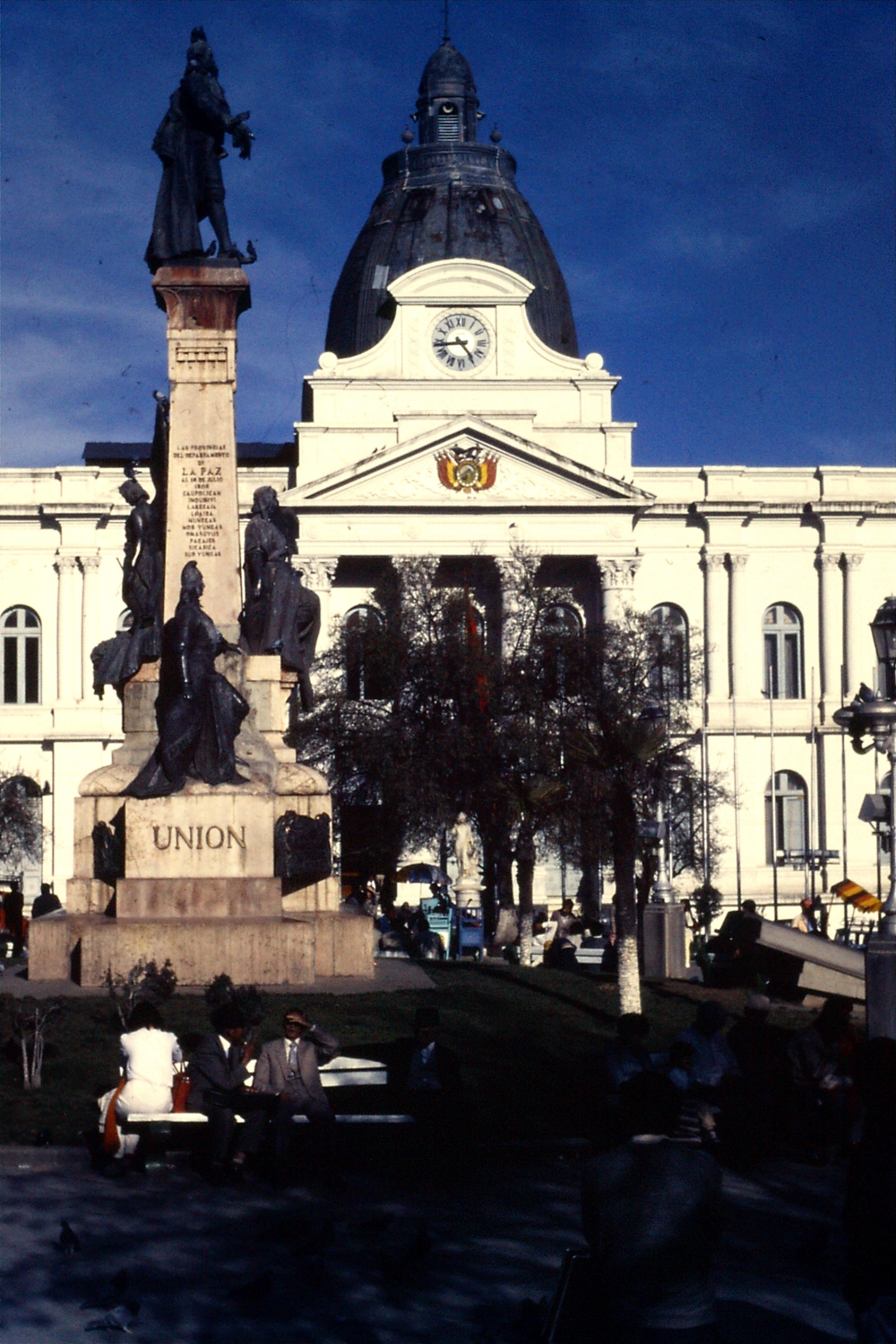
There were a lot of people and video cameras, plus a huge Policia presence, in the Plaza Murillo where a big crane was replacing the bells in the tower of the huge cathedral. Murillo Square is located in the centre of the city of La Paz, it became the centre of political power in Bolivia after the transfer of the Executive Power to La Paz as a result of the Federal War of 1899.

This space was conceived 10 years after the foundation of the City of Our Lady of La Paz, on 20th October 1548, that is, in 1558 by order of the corregidor Ignacio de Aranda.

This square was designed on the other side of the Choqueyapu River far removed from the main square in Churubamba where Alonso de Mendoza founded the city. The design obeyed the ordinance of the Spanish cities delineated in the form of a checkerboard, with symmetrical, rectangular blocks of equal dimensions.

At the beginning of the nineteenth century the Plaza Mayor of La Paz was the epicenter of the power of the city and the main stage of public life. Around it were located the buildings of the main institutions, the Cabildo de La Paz was located in the southeast corner (in what is now the Government Palace), the Main Church in the west corner (current cathedral), the Royal Boxes in front of the Cabildo (today the Prefecture), while the Barracks was on the north sidewalk (today the Café París).

The residences of the most notable neighbours were also in this Square, such as the imposing Palace located on the corner of Comercio and Socabaya streets, built in 1775 as the home of D. Francisco Tadeo Diez de Medina. Later known as The Palace of the Counts of Arana and current National Museum of Art. Prominent citizens, merchants and important owners had shops and houses in the immediate vicinity.

We crossed the main avenue at the junction of Mariscal Santa Cruz and 16 de Julio, it’s central reservation dotted with statues, including the obligatory Simón Bolívar. This was fair enough as El Libertador, or Liberator of America, was a Venezuelan military and political leader who led what are currently the countries of Colombia, Venezuela, Ecuador, Panama, Peru, and Bolivia to independence from the Spanish Empire.

We found an expensive touristy market by the plaza in front of the Basilica de San Francisco. The Minor Basilica of San Francisco in the city of La Paz, Bolivia, is a Catholic temple under the invocation of San Francisco de Asís. It is located in the city centre. It is part of the conventual complex that gives its name to the adjacent Plaza Mayor de San Francisco. It was built between the sixteenth and eighteenth centuries in the so-called mestizo baroque style. The Franciscan convent is the oldest registered religious house in the city, appearing in 1547, before its foundation in 1548.

We continued up the hill on the other side of the main drag and entered an extensive area of street market stalls selling toiletries, nylon bags, imitation American clothing and all manner of plastic goods. There was also a small witchcraft market where half a dozen old indigenous Indian women sold mysterious coloured powders and dried plant and animal parts.

At 14:30 hrs. we went back to the Hotel Rosario, disenchanted with La Paz market. Here we met Bill Robertson from Scotland and Pen from New Zealand, the two older men that I’d previously met on the boat to Taquile Island on Lake Titicaca.

Together we all walked down to Club Andino Boliviano to find out about skiing at Chacaltaya, the highest ski piste in the world at 5,375m (17,634 feet) metres above sea level. There was a transport strike on in La Paz so it took a while to sort out how we were going to get there.

We sat in the Club’s Board Room while the Club Secretary phoned around. We eventually agreed on paying 20 Bolivianos each for a Toyota without seats plus 28 Bolivianos each for ski hire and petrol for the drag lift. We would leave tomorrow at 08:00 hrs.

We then went out shopping for tomorrow’s day out on the piste, trying in vain to find a supermarket. There was a huge procession with glum music on the main avenue. The base of a golden floral display seemed to be a coffin. If it was a funeral, it must have been for somebody famous.

On the way back I found the well-camouflaged Post Office and bought some postcards and stamps. That evening I went to see “The Living Daylights”, the last James Bond film with the new Bond. The Living Daylights is a 1987 British spy film, the fifteenth entry in the James Bond series produced by Eon Productions, and the first of two to star Timothy Dalton as the fictional MI6 agent James Bond.

Directed by John Glen, the film's title is taken from Ian Fleming's short story "The Living Daylights", the plot of which also forms the basis of the first act of the film. It was the last film to use the title of an Ian Fleming story until the 2006 instalment Casino Royale. Excellent escapism.

Surprisingly there were only a few other people in the cinema. Most of the La Pazians were queuing for the many liquidation sales along Jiron Junin pedestrian precinct. I had Chinese rice with chicken and a beer in the Catay Restaurant before going back for an early night at 22:00 hrs.

La Paz

Above: La Paz, Bolivia.

Monday 18th April 1988

I said “adios” to Anita and Reinhard who were returning to Cuzco by train and set off to get a colectivo from a point on Avenida el Ejercito, which was two blocks past the hospital. As usual we had to wait for a full complement of passengers before we could leave.

A Dutch couple made up the numbers at 07:30 hrs. and we set off along the southern shores of the great Lake Titicaca. It cost 130 I/- for the two-hour trip to Yunguyo along a bumpy road with good scenery, passing a number of brown mud brick towns. Fishermen plied among the reeds on rush canoes on the lake.

Yunguyo is a town in the Puno Region in southeastern Peru. It is the capital of Yunguyo Province and Yunguyo District. Yunguyo is located on a peninsula on the shores of Lake Titicaca. The border with Bolivia runs next to the town and a road connects it with the town of Copacabana located a few kilometres away on the Bolivian side of the peninsula.

At Yunguyo we found a tranquil pleasant town where stocky Indian women changed money from wooden boxes under big parasols. They weren’t too keen on changing Intis and only wanted $US dollars.

We had the usual wait for a full bus load in a dusty side street. I changed my remaining Intis into chocolate. At last, at 11:00 hrs. we set off for Copacabana. This cost 1 Boliviano, the basic unit of money in Bolivia; equal to 100 centavos, and there were 2.3 Bolivianos to the American dollar.

We were stamped out of Peru, some of us having to pay 5 I/- for a mysterious ticket which probably a contribution to the Customs Officers Beer Fund. We checked in at Bolivian Immigration and although an official said he would like to search our bags we ignored him, feigning non-comprehension of Spanish, and we jumped back onto the bus unmolested.

We bumped down an atrocious road into the Bolivian town of Copacabana, a pleasant looking place for a border town, and a quick dash and 5 Bolivianos got us the last three seats on the 13:00 hrs. bus to La Paz.

We had some makeshift collapsible seats in the central aisle, but it was better than standing for five hours for the 147.2 km (92 mile) road journey. Our fellow passengers were bowler-hatted women with babies wrapped in colourful blankets and sturdy Indian men in suits and trilbys.

The road was a pretty bad dirt track so it was a welcome break to get off the bus for the ferry crossing across the Estrecho de Tiquiña, a narrow constriction at the south east end of Lago Titicaca.

The Strait of Tiquina is located on Lake Titicaca on the Bolivian side of this, in the department of La Paz. It is a separation (or union), of the two bodies of water that make up Lake Titicaca, the largest part in the north called Chucuito and the smallest in the south called Huiñaymarca. It has a width of about 780 meters, which can be easily crossed by powerboat.

A passenger raft service runs through it permanently, and pontoons are used for vehicles. This route is part of the road that connects the city of La Paz and the coastal city of Copacabana on the border with Peru. We paid 0.5 Bolivianos for the bumpy trip across in a launch, while the bus was taken over separately on a flat landing craft.

On the east bank was a colourful statue of a Bolivian soldier bayoneting a Chilean. The legend promised that what once belonged to Bolivia would do so again in the future. This was a protest to Chile cutting Bolivia off from the sea.

We continued through nice scenery, the wide flat altiplano and the snow-capped bounding mountains. At 17:00 hrs. we came to the outskirts of La Paz, officially known as Nuestra Señora de La Paz, and also Chuqi Yapu in Aymara, which is the seat of government as well as the legislative and executive capital of the Plurinational State of Bolivia.

The city, in west-central Bolivia 68 kilometres (42 miles) southeast of Lake Titicaca, is set in a canyon created by the Choqueyapu River. It is in a bowl-like depression, part of the Amazon basin, surrounded by the high mountains of the Altiplano. Overlooking the city is the towering, triple-peaked Illimani. Its peaks are always snow-covered and can be seen from many parts of the city.

At an elevation of roughly 3,650 metres (11,975 feet) above sea level, La Paz is the highest capital city in the world. Due to its altitude, La Paz has an unusual subtropical highland climate, with rainy summers and dry winters.

La Paz was founded on 20 October 1548, by the Spanish conquistador Captain Alonso de Mendoza, at the site of the Inca settlement of Laja as a connecting point between the commercial routes that led from Potosí and Oruro to Lima.

The low mud brick buildings and rough alleyways looked like a scene from a “Mad Max” film. The traffic threw up trails of dust. Road works were underway, and the setting sun silhouetted the workers against the fog of brown dust.

The drive into the centre was painfully slow with numerous stops for people to get off and retrieve their anonymous looking sacks from the roof rack. The town was concentrated in a huge bowl amongst the mountains. Crude housing clinging to the outskirting highland descended to a central cluster of modern skyscrapers.

The dominating snow-capped mountain overlooking the city was turning red as the sun went down. Illimani is the highest mountain in the Cordillera Real (part of the Cordillera Oriental, a subrange of the Andes) of western Bolivia. The snow line lies at about 4,570 metres (15,000 feet) above sea level, and glaciers are found on the northern face at 4,983 m (16,350 feet). The mountain has four main peaks; the highest is the south summit, Nevado Illimani, which is a popular ascent for mountain climbers.

We got off the bus in a seedy side street and began walking downhill into the city centre. It was the evening rush hour and we walked down against the tide of workers who were homeward bound. The pavement was choked with squatting Indian street traders, their wares spread out on blankets, so we were forced to walk in the cobbled road alongside the impatient traffic.

I split from the Dutch couple who were going to a different hotel and found my way through a bustling pedestrian precinct to the Plaza Murillo. From here it was only a few yards downhill to the Hotel Torino on Calle Socabaya.

Above: Hotel Torino in La Paz.

I got a huge single room in this old convent (monastery?) for 5.50 Bolivianos in the cloisters overlooking the central courtyard. I threw in my bags and got the receptionist to put in a new socket and light bulb so that I could see.

I then went for a short walk around. I dined in the Catay Chinese Restaurant, just off Plaza Murillo and had my first Bolivian beer. The bottle had a colourful label, but it foiled all my attempts to get it off without tearing it.

My final walk around the locality revealed a very modern area of neon-lit shop signs and fast-food restaurants, cinemas and steep sloping streets. Army-like Policia stood in groups in ponchos on street corners with visible, business-like weapons and gas grenades. They looked very bored.

I returned to the Hotel Torino for an early night.

Schiphol

Tuesday 21st June 1988 I got up at 07:00 hrs. and showered before trying to cram all of my gear and my new purchases into my Karrimor ruck...