Thursday, May 26, 2022

Ouro Preto

Friday 27th May 1988

We arrived at Ouro Preto just after the grey dawn. A man outside the Rodoviário Bus Terminal had handed me a card for the Pousada Ciclo de Ouro at Felipe dos Santos 241. This cost 700 Cruzados for Bed and Breakfast.

The historic colonial town was scattered about the steep green hills below the Ouro Preto Bus Terminal. Distinctive curved tiled roofs, steep slippery rain-slick cobbled streets and more churches than you could shake a stick at!

I had breakfast at the pleasant friendly guest house where I met Uli from Berlin and Tom from Holland. After breakfast we went out to see the town. It was like something out of a time machine, apart from the modern cars.

Founded at the end of the 17th century, Ouro Preto (meaning Black Gold) was originally called Vila Rica, or "Rich Town", the focal point of the gold rush and Brazil's golden age in the 18th century under Portuguese rule. Between 1695 and 1696, a gold-bearing stream was discovered in Itacolomi, which would be renamed Gualacho do Sul.

In 1711, several small settlements were united as a municipality called Villa Rica, which later came to be called Ouro Preto. This name was adopted on 20th May 1823, when the former Vila Rica was elevated from village to city. "Black Gold" comes from the gold covered with a layer of iron oxide that is found in the city.

The city centre contains well-preserved Portuguese colonial architecture, with few signs of modern urban development. New construction must keep with the city's historical aesthetic. 18th- and 19th-century churches decorated with gold and the sculptured works of Aleijadinho make Ouro Preto a tourist destination.

The tremendous wealth from gold mining in the 18th century created a city which attracted the intelligentsia of Europe. Philosophy and art flourished, and evidence of a baroque revival called the "Barroco Mineiro" is illustrated in architecture as well as by sculptors such as Aleijadinho, painters such as Mestre Athayde, composers such as Lobo de Mesquita, and poets such as Tomás António Gonzaga. At that time, Vila Rica was the largest city in Brazil, with 100,000 inhabitants.

Rich people believed that by building a church it would give them guaranteed entry to heaven. We went to one of these ornate churches with a museum containing paraphernalia such as chalices in gold and silver, paintings and sculptures of saints being pious. There were gory crucifixion works, souls in torment pictures and all the usual Catholic religious gubbins.

We walked up to a solid church on a high point overlooking the whole town where a couple of kids flew kites. We walked back to the central Praça Tiradentes (The place where the head of the martyr of independence, Joaquim José da Silva Xavier, tiradentes was exposed (1792) in Vila Rica, present-day Ouro Preto.), wading through the gemstone touts and caught a bus to the Minas da Passagem.

Halfway between Ouro Preto and Mariana, this ancient gold mine was founded by the Portuguese in 1719 and definitively decommissioned in 1985. Here we paid an excessive 500 Cruzados for a run into the abandoned mineshaft on the miners train.

Google research reveals that The Passage Mine is one of the largest mines still existing for visitation in the world, located in the Brazilian municipality of Mariana, in the Quadrilátero Ferrífero area, in the state of Minas Gerais. Located in the district of Passagem de Mariana and about 7,200 km² long, the mine of the passage is the largest mine in this region with its 30 km of tunnels, with underground lakes of crystal-clear waters.

In 1729, the first mine deposits were discovered, which only began to be explored more than 100 years later. During the gold cycle in Minas Gerais by the Portuguese and English who even extracted 35 tons of gold. The mine was shut down in 1954 but was reopened for visitation in the 1970s. Nowadays the mine is used for tourism, it is one of the largest meeting points for cave divers in Brazil.

We saw rusting machinery, a shrine to the miner’s patron saint, St Procopius, and a blue subterranean lake of copper sulphate solution. Apparently, the gold miners had a dicey job risking silicosis and arsenic poisoning.

We returned to town and visited the mineral museum where we saw beautifully coloured gems and minerals. Apparently, it was one of the largest collections of rocks and minerals in the world, including diamonds, uranium, topaz, quartz, agates and much more. It is housed inside the School of Mines.

We then visited a rather ornate church, partly to stay out of the rain. I bought birthday cards for my sister Katy Subanney and my dad, Harry Hawkins, and wrote them over a coffee in a café by the Post Office.

Back at the hotel I had a long overdue shower and joined Uli and Tom to see “Superman IV” at the town cinema. Superman IV: The Quest for Peace is a 1987 superhero film directed by Sidney J. Furie and written by Lawrence Konner and Mark Rosenthal from a story by Christopher Reeve, Konner, and Rosenthal based on the DC Comics character Superman.

The film stars Reeve, Gene Hackman, Jackie Cooper, Marc McClure, Jon Cryer, Sam Wanamaker, Jim Broadbent, Mariel Hemingway, and Margot Kidder. It was the fifth film in the Superman film series and a sequel to Superman III (1983). It was also the final appearance of Christopher Reeve as Superman.

We had a good evening meal in the cellar restaurant on the steeply sloping Rua Conde Bobadela and left the establishment too early, missing the live music as we were all too tired. The town was livening up with a wealth of young students out on the streets.

I went to bed and fell asleep immediately despite the noise of revelry outside.

Pão de Açúcar

Thursday 26th May 1988

Another miserable day but I was determined to get some photographs of Rio de Janeiro regardless of the weather. I took the bus in the drizzle to the border of Leblon and Ipanema so that I could get photos of Ipanema Beach and the Lord Jim Pub.

The beach was deserted, and the palm trees swayed in the wind. A few joggers splashed along through the shallow puddles on the promenade. I continued along Copacabana Beach which looked bleak under the low grey cloud, a far cry from the lively crowded beach full of glamourous people that it was on Sunday.

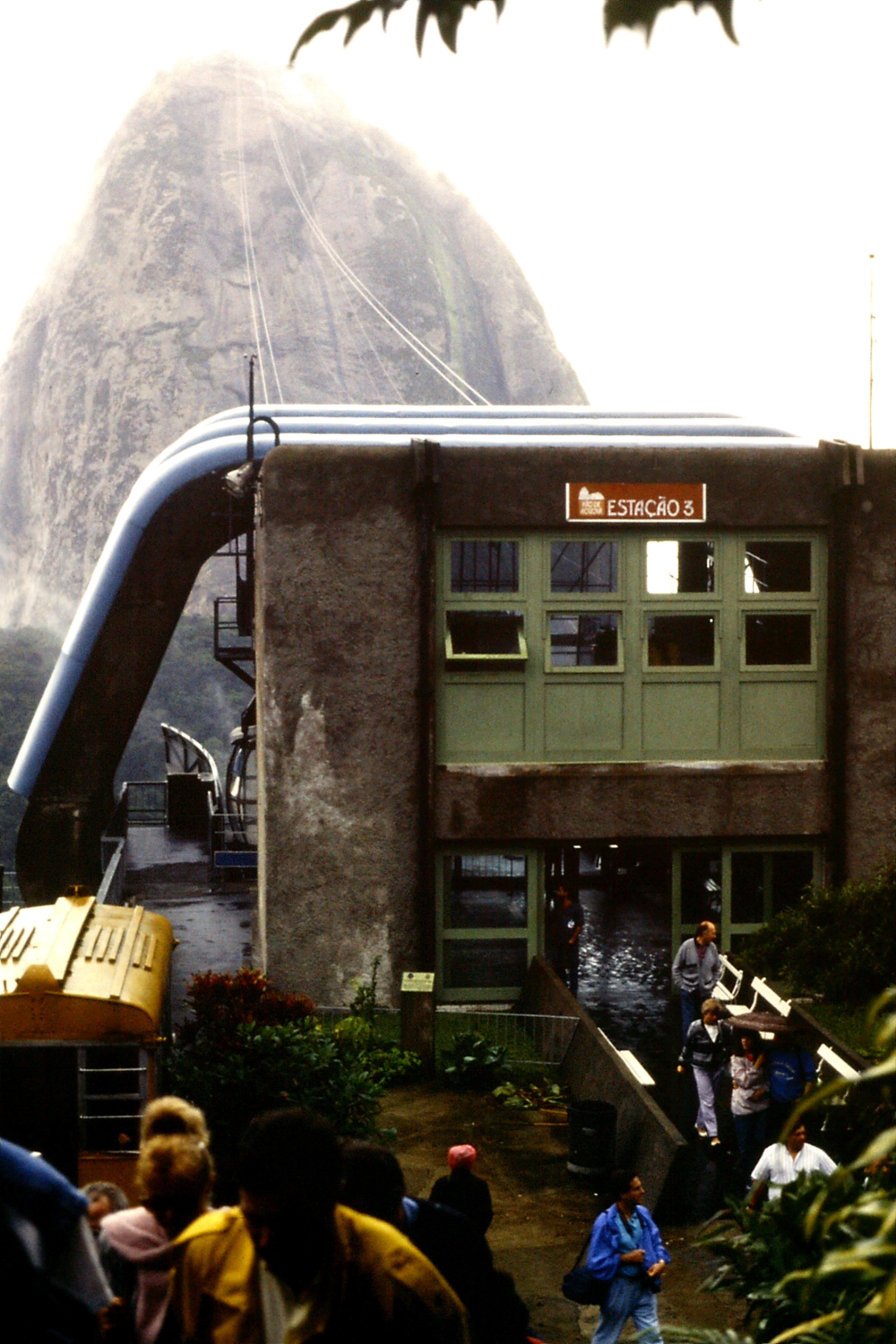
I took the 511 bus, when I eventually got one to stop, from the Avenida N. S. Copacabana to the Sugar Loaf Mountain or Pão de Açúcar. Outside the cable car station a few miserable looking stall holders crouched under polythene sheets which protected their souvenir T-shirts and knick-knacks from the rain.

The Sugarloaf Cable Car (Portuguese: Bondinho do Pão de Açúcar) is a cableway system. The first part runs between Praia Vermelha and Morro da Urca (at 722 feet (220 metres)), from where the second rises to the summit of the 1,299-foot (396 metres) Sugarloaf Mountain.

The cableway was envisioned by the engineer Augusto Ferreira Ramos in 1908 who sought support from well-known figures of Rio's high society to promote its construction. Opened in 1912, it was only the third cableway to be built in the world. In 1972 the cars were updated, growing from a capacity of 22 to 75, and in 1979 it featured in an action scene for the James Bond film Moonraker.

I paid 540 Cruzados for a return ticket to top of the Sugar Loaf. This was a two-stage trip, and at the first stop there was a good view of central Rio and the yachts mooring in the bay, but it was gloomy and drizzling with rain.

There were only four other sightseers. Two elderly women and a couple of young lovers who stared into each other’s eyes on the balcony, oblivious to the weather and the view. As the cable car ascended to the ultimate summit station we passed into the cloud and from then on it was like being on the inside of a ping pong ball.

At the top you could barely see thirty metres to the souvenir shop and the tourist café. We had a quick look around in the rain, seeing dejected tropical birds in cages around the terrace before sitting in the top station to await the car back down to the bottom.

I caught the 511 bus, which went back to Copacabana by a long, torturous route which meant that I got back too late to catch the film at 14:00 hrs. at the cinema. Thus, I had two hours to kill before the next showing.

I had lunch in McDonalds and some excellent chocolate cake on the corner of Avenida Perú and Avenida Atlantica. Then I went window shopping. I bought a cheap slide film, which was cut from a long reel (bulk film spool) and loaded into a recycled film cassette to fit the camera.

This caused problems as the slide film was put into a print film canister and it was developed accordingly to give me oddly coloured 35mm transparencies as a record of my journey between Rio de Janeiro to Manaus in Amazonas.

I also got some more laundry washing powder and looked in the beachwear shops at the T-shirts and minimal bikinis in colourful displays. On my way back to the cinema I met Lesley, the Australian girl who was with Harry when I last saw her in Cuzco and we caught up on our recent experiences.

I dashed down to the flicks just in time for the start of the programme. There was a bizarre first film which presented black and white slides of bound and violently murdered people with an operatic soundtrack.

The main film was “Saigon”, a good cop partnership movie set in the unusual setting of Vietnam. “Off Limits” is a 1988 action-thriller film set during the Vietnam War starring Willem Dafoe and Gregory Hines and directed by Christopher Crowe. The term "off limits" referred to the area where the original crime took place, an area of Saigon off limits to military personnel. The name of the film was changed to Saigon or Saigon: Off Limits when it was released throughout the rest of the world.

On the way back to the Youth Hostel I bought a red and white striped top for my mum. I went out for a pizza and a couple of beers with Jim and Nikki. She had been valiantly trying to learn Portuguese from Wilson, the hostel doorman and security guard.

After eating Jim came with me on the 127 bus as far as the cake shop on Avenida Perú and then I was on my own on the bus with my baggage, feeling very vulnerable as we passed a particularly dodgy area near the Rodoviário Bus Terminal.

I talked to an English-speaking Brazilian girl while waiting for the bus which left promptly at 23:30 hrs. I slept for most of the night, waking only for the two stops for something to drink.

Tuesday, May 24, 2022

Lord Jim Pub

Wednesday 25th May 1988

It was a grey morning and before long the rain started again. I bought breakfast in the big supermarket just down the road and loitered in the hostel with the other guests until we were kicked out at 12:00 hrs. noon. I went with José, the Portuguese guy, to a cheap restaurante which was upstairs from a virtually unmarked door on the street.

Here we got a damn good meal for 200 Cruzados. José left on the bus on his way to São Paulo and I went for a walk around the shops on Ribeiro Barata and N. S. Copacabana, taking and interest in those selling photographic film, vinyl records and beachwear. I got a dubious slide film for 1,300 Cruzados.

I went on to browse in an open-fronted record shop where a crowd had gathered watch a Girls of Rio Video. I walked through the sodden fruit and vegetable market, did a couple of pull ups on the deserted beach, bought some laundry soap powder, and then went to the flicks (cinema) to see “Razorback”.

This was a good Australian film released in 1984 and mostly shot in Broken Hill, New South Wales with some excellent photography. Director of photography Dean Semler was hired on the strength of his work in Mad Max 2.

As a vicious wild boar terrorizes the Australian outback, the husband of one of the victims is joined by a hunter and a farmer in a search for the beast. Back at the Youth Hostel I wrote a postcard recommending the film to my friend Austen Simmons, who considered himself something of a film buff.

Jim went off to the Rodoviário Bus Terminal to check out some bus times and I did some research on the way ahead with the South American Handbook 1988. When Jim returned, we walked into Ipanema for a meal at the Kozihna Brasileiro.

We then hurried through the pissing rain to the Lord Jim Pub on Rua Paul Redfern. This was billed as a Bar Inglês. It was a good copy of an English Public House with an old red telephone box outside. Inside there were horse brasses, English signs, a dart board and an English Sunday lunch atmosphere. Pubs in England were only open from 12:00 noon to 14:00 hrs on Sunday lunchtimes so there was some enthusiastic drinking to make the most of the two hours.

It made a change to hear a few English voices, although most were American. It was reputed to be Ronnie Biggs local when he was on the run. Great Train robber Ronnie Biggs was the best-known member of a gang that stole £2.6 million from a Glasgow-to-London mail train in 1963.

Biggs was caught after the robbery and received a 30-year jail sentence but escaped from Wandsworth prison in south London after 15 months and spent 36 years on the run, leading a playboy lifestyle in South America.

He became a familiar figure in the Lord Jim Pub in Ipanema, and around his neighbourhood in Santa Teresa, where he would invite paying guests to hear his stories as a way to make money after the robbery stash ran out.

He is still remembered in Brazil. Newspapers and magazines ran news of his death on the front of their websites yesterday. Veja described the Londoner as “the thief of the 20th century”, while Folha de Sao Paulo ran a photograph of Biggs giving a two-finger salute. Globo carried old newspaper pages reporting the attempts to extradite Biggs from his home in Rio.

We had a few Chopps beers and then took the bus back to Copacabana at 22:00 hrs.

MNBA

Tuesday 24th May 1988

I awoke to a dull, dreary rainy morning. Most people staying at the Youth Hostel loitered about despondently until the midday deadline forced them out onto the streets in the gloom. Hostellers had to vacate the hostel for each afternoon.

I went into the city centre with the Portuguese guy who was wearing an Xmal Deutschland T-shirt. Xmal Deutschland, often written as X-Mal Deutschland, was a musical group from Hamburg, West Germany, which existed from 1980 to 1990. Founded in 1980 with a completely female line-up, they became chart hit makers both within, and outside, their native country. The lead singer of the band was vocalist Anja Huwe. Xmal Deutschland's last album was released in 1989.

We went to the Portuguese Airline Office where he was dismayed to find that all the flights back to Portugal were fully booked until July. He made a provisional booking on his open ticket and we went for a walking tour of the city centre. The rain-washed streets were packed with people.

We looked around The Museu Nacional de Belas Artes (MNBA; Portuguese for National Museum of Fine Arts) which is a national art museum. The museum, officially established in 1937 by the initiative of education minister Gustavo Capanema, was inaugurated in 1938 by President Getúlio Vargas.

The museum collection, on the other hand, takes its rise in the transfer of the Portuguese Court to Brazil in the early 19th century, when King John VI brought along with him part of the Portuguese Royal Collection. This art collection stayed in Brazil after the King's return to Europe and became the core collection of the National School of Fine Arts. When the museum was created in 1937, it became the heir not only the National School collection, but also of its headquarters, a 1908 eclectic style building projected by Spanish architect Adolfo Morales de los Ríos.

The Museu Nacional de Belas Artes is one of the most important cultural institutions of the country, as well as the most important museum of Brazilian art, particularly rich in 19th-century paintings and sculptures.

The collection includes more than 20,000 pieces, among paintings, sculptures, drawings and prints, of Brazilian and international artists, ranging from High Middle Ages to contemporary art. It also includes smaller assemblages of decorative arts, folk and African art. The museum library has a collection of about 19,000 titles. The building was listed as Brazilian national heritage in 1973.

We were intrigued by the varied selection of old and modern paintings and then went out to browse along the extensive magazine stalls, sneakily reading the English music papers, New Musical Express (NME), Sounds and Melody Maker which were too expensive for us to buy.

We went on to the Rodoviária do Rio Bus Station which was inaugurated in 1965 and is the second biggest one in South America. I bought a ticket to Ouro Preto for 1,200 Cruzados for Thursday night at 23:30 hrs.

Ouro Preto (Black Gold), formerly Vila Rica (Rich Town), is a city in and former capital of the state of Minas Gerais, Brazil, a former colonial mining town located in the Serra do Espinhaço mountains and designated a World Heritage Site by UNESCO because of its outstanding Baroque Portuguese colonial architecture.

Ouro Preto is located in one of the main areas of the Brazilian Gold Rush that started in the 1690’s. Officially, 800 tons of gold were sent to Portugal in the eighteenth century, not to mention what was circulated in an illegal manner, nor what remained in the colony, such as gold used in the ornamentation of the churches.

The Sugar Loaf was shrouded in cloud and the rain got heavier as we thundered back to Copacabana on the kamikaze bus. We ran, as best we could in flip-flops through the downpour back to the Youth Hostel, picking up a whole cooked roast chicken and a bottle of wine en route.

Wilson, the hostel doorman turned a blind eye to our consumption of alcohol on the premises but told us to hide it from the girls on the reception desk. In the dormitory we lounged around as the rain became torrential outside the window. Swirling brown rivers hurtled down the gutters of the steep cobbled lane outside the Youth Hostel. I started to read “Carnival of Spies” by Robert Moss, published in 1987.

The review in Publishers Weekly said: Perceiving how cruelly workers are treated in the early years of the 20th century, poor Hamburg boy Johnny Lentz idealistically turns to communism. Trained in Moscow as an expert in promoting revolution, he is dispatched throughout Europe, then to China and later to Brazil to help local organizers.

The purge of his best friend, however, leads him to realize that Soviet leader Stalin has become improbably enamoured of and secretly helpful to Hitler, a man who should be the Soviet Union's enemy. Disillusioned, Johnny becomes a double agent for England and must choose between the love of two sisters who may betray him if his collaboration is revealed.

Robert Moss (Moscow Rules) has done excellent research, using such historical incidents as a little-known communist uprising in Brazil during the '30s to great effect, and his gritty descriptions offer vivid glimpses of different cultures. Although the characters lack depth and Moss relies too often on formulaic thriller devices and dialogue, the novel is nonetheless an absorbing read.

The rain didn’t look like it was going to stop so Jim and I nipped down to our usual nearby stand-up restaurant for lasagne. Afterwards we walked around for a bit in search of a good cake shop and then returned to the Youth Hostel as all was quiet, wet and miserable in the town.

I had a long hot shower and then read some more of my book before going to sleep early at 22:30 hrs.

Monday, May 23, 2022

Corcovado

Monday 23rd May 1988

I awoke quite early thanks to the dreadful din from the building site opposite and got up to write some letters and postcards in the common room. At 10:30 hrs. I went out with Jim to the Post Office and then we did a survey of the cambios in order to change up some travellers cheques.

The “official rate” in American Express was 155 Cruzados to the $US dollar but we got 200 Cruzados at the Diamond Jewellers at Avenida Nossa Senhora de Copacabana 387-B. I bought another expensive slide film for my camera for 2,400 Cruzados on the way back to the Youth Hostel.

I got my camera and we headed for the Corcovado, the prominent hill with the statue of Christ the Redeemer on the top. Bus 583 from Avenida Nossa Senhora de Copacabana hurtled through the suburbs, narrowly missing vehicles and pedestrians alike, using a maximum of braking and acceleration to keep us passengers off balance.

We arrived at the bottom of the hill and paid 500 Cruzados for a return train trip to the summit. The red, subway-like train hauled us up the steep track to a superb panoramic view of Rio de Janeiro threading between the lakes and hills below. The big Jockey Club Racetrack was particularly noticeable.

The Corcovado Rack Railway (Portuguese: Trem do Corcovado) is a mountain rack railway which runs from Cosme Velho to the summit of Corcovado at an elevation of 710 m (2,329 ft). The railway was opened by Emperor Dom Pedro II of Brazil on 9th October 1884. Initially hauled by steam locomotives, the line was electrified in 1910, a first in Brazil. It was re-equipped in 1980 with trains built by Swiss Locomotive and Machine Works (SLM) of Winterthur, Switzerland.

The line is 3.824 kilometres (2.376 miles) long and has four stations total. There are three trains, each made of two cars. The trip takes approximately 20 minutes and departs every 20 minutes, giving a capacity of 540 passengers per hour.

We matched up the view with our map. All around us tourists were busy with their cameras and video recording cameras around the huge statue with the outstretched arms in spite of the grey cloudy sky.

We went back down on the train and took a bus back to Copacobana, following a long circuitous route through the Jardim Botanico, Leblon and Ipanema. We browsed through the numerous book and magazine shops on the walk back to the Youth Hostel from the bus stop.

It was getting dark and the long-threatened rain had just started to fall. Everybody in the dormitory sat about on their beds reading while a stiff breeze lashed the palm tree outside the window. A Portuguese bloke arrived and began swigging from a bottle of sherry.

He was going to see the English rock band “Gene loves Jezebel” and I decided to join him. The concert was on in a big cabaret hall just the other side of the tunnel that linked Copacabana to Botafogo.

A young crowd gathered in the venue drinking Chopp beer from plastic cups. There were a few token ripped jeans in evidence, but the majority were pretty clean cut kids. Billed here as the top band from the UK, Gene Loves Jezebel are a British rock band formed in the early 1980s by identical twin brothers Jay (born John) and Michael Aston. The name of the band is a reference to rock musician Gene Vincent and his song "Jezebel".

Gene Loves Jezebel's best-known songs include "Heartache", "Desire (Come and Get It)" (1986), "The Motion of Love" (1987), "Jealous" (1990) and "Break the Chain" (1993), as well as alternative club hits "Bruises" (1983), "Influenza (Relapse)" (1984) and "The Cow" (1985). "The Motion of Love" was the band's most successful UK single. The band were an enjoyable glam rock outfit with long hair and camp poses.

We looked for a lively place for final drink in Copacabana before going back to bed, but it was pretty dead. We settled for a McDonalds instead and demolished a huge avocado in the common room before turning in at 01:00 hrs.

Sunday, May 22, 2022

Ipanema

Above: Ipanema Beach on a gloomy May day. Sunday 22nd May 1988

After a long lie-in I walked with Jim towards Ipanema along the waters edge. The white sand was lost beneath bronzed people engaged in beach activities. Jim had forgotten his security locker key and went back to the hostel to get it while I waited on the front and watched the crowd go by.

Sexy girls, happy children, people young and old cheerful at the prospect of a lazy sunny Sunday on the beach. Jim returned and we walked into Ipanema which is a neighbourhood located in the South Zone of the city of Rio de Janeiro, between Leblon and Arpoador.

The beach at Ipanema became known internationally with the popularity of the bossa nova jazz song, "The Girl from Ipanema" ("Garota de Ipanema"), written by Antônio Carlos Jobim and Vinícius de Moraes.

We browsed amongst the arts and crafts of the “hippy fair” at Praça General Osório. Paintings, batiks, leather goods and ceramics were on display for sale. We found a restaurant at the corner of the praça at Cozinha Brasileira on the Rua Visconde de Pirajá where we got a huge meal consisting of rice, chicken, spaghetti, potatoes and vegetables for 350 Cruzados. After a strawberry juice next door, we went down to Ipanema Beach.

We met a guy from Finland that Jim knew, and he watched our gear while we went swimming in the violent sea. The Atlantic Ocean here had a savage undertow. Thieves were everywhere in Rio and unguarded gear left on the beach tended to disappear almost immediately. The Fin had his trousers stolen on Copacabana Beach yesterday, while he was reading a book.

It was like a film set or a tourist brochure with sun, sea, sand and pretty women in bikinis everywhere. The song "The Girl from Ipanema" played in my head. After a while we walked inland to see the big Lagoa (lake). Rodrigo de Freitas Lagoon (Portuguese: Lagoa Rodrigo de Freitas) is a lagoon in the district of Lagoa in the Zona Sul (South Zone) area of Rio de Janeiro.

The lagoon is connected to the Atlantic Ocean, allowing sea water to enter by a canal along the edge of a park locally known as Jardim de Alah. The lagoon was surrounded by lakeside hotels. We walked back to Copacabana where I bought a vest for the hot weather to come and swam in the gentler surf of Copacabana beach.

At 16:30 hrs. we went back to the Youth Hostel for a shower. Down-and-outs (homeless) sat in doorways and outside the church. “If you have to live in somebody’s doorway, I guess Copacabana is a good place to do it”, said Jim. Most of the people living on the streets looked very fit and affluent despite their lack of clothing and possessions.

After a shower and a change of T-shirt I went out to get something to eat with Jim. We finally settled for a meal of chicken and lasagne at a stand-up corner bar. Afterwards we walked along the front towards the Sugar Loaf Mountain, stopping to drink coconut juice from green coconuts which the short-changing youth at the kiosk dangerously hacked open with a meat cleaver.

Joggers and lovers monopolised the seafront promenade on our return. We had some chocolate cake and had a beer. Drunks and vagrants slept on the sidewalks as the affluent headed for the night clubs in their sequined outfits.

Back at the hostel the security doorman verified our identity through a hatch in the door before letting us in. This was a sign that Rio could be a dangerous place as well as a playground.

Saturday, May 21, 2022

Copacabana

Saturday 21st May 1988

I got a local bus to the city centre and checked the Poste Restante in the huge old Post Office, but there was nothing for me. A subsequent walk about revealed that it was not a good time to visit the city centre. Most of the shops were shut and the Modern Art Museum and the National History Museum were closed for renovation, and the Image & Sound Museum was closed because it was Saturday.

I had brunch in McDonalds again! Bought some postcards and wrote them in the pleasant Campo de Santana Park which is a park located in the Praça da República in downtown Rio de Janeiro. The name of the plaza refers to the fact that it is located near the site where the Brazil was declared a Republic in 1889.

During the colonial period in Brazil, the area currently occupied by the park was an enormous swamp. Over time, the swamp was filled in and used as a public space. The region became known as "Campo da Cidade"/"Campo de São Domingos" and served as a divider between downtown Rio de Janeiro and the rural areas surrounding it.

In 1753, it became known as "Campo de Santana". This name originated with a church that was constructed in the region that developed a large number of devotees. The church was demolished in 1854 to make way for the first urban railroad station in Brazil, the Dom Pedro II Station. Later, on the site of this first station, the city's Central Station was built.

Agoutis which are animals like rabbits with rat-like heads and long legs scampered amongst the trees. A mad woman sat shouting on a bench by the river and the locals strolled in the shade, chatting.

After a bit of a hunt, I found a bus stop and caught a bus back to Copacabana, regarding everyone on the bus with suspicion as an Australian traveller was robbed at knifepoint on a crowded bus a couple of days ago. I had left my valuables and passport in the safe at the Youth Hostel and only went out with a few dollars cash in my pocket while I stayed in Rio de Janeiro.

Back in the Youth Hostel common room I met Jim, an American, and Nicki who was English, and we went out for a meal together. We had lasagne and several drinks at a popular restaurant nearby. Afterwards Jim and I walked along the seafront promenade, pausing to try our hand at pull-ups and dips at the beach gyms. We had another couple of beers on the way back to the Youth Hostel.

Schiphol

Tuesday 21st June 1988 I got up at 07:00 hrs. and showered before trying to cram all of my gear and my new purchases into my Karrimor ruck...