Tuesday, December 14, 2021

Mexican Hat Dance

Wednesday 9th December 1987

The early hours of this morning were filled with the sounds of donkeys braying tormentedly and an array of bizarre bird calls. A weird insect made a cluttering sound as it did what Declan described as a “Mexican Hat Dance”.

We got up just after the sun rose and headed for the beach and a battle with the surf. Dangerous undercurrents made us stay within our depth. Locals walked along the beach carrying huge machetes on their way to work.

Back at the hotel we had a Mexican omelette for breakfast and set of to see what the village of Puerto Ángel had to offer. This involved a 25-minute walk along a very dusty track under a merciless sun and we were grateful for a cold Pepsi Cola half way, and a couple of Sprite drinks on the seafront at the finish.

Sprite is a colourless, lemon and lime-flavored soft drink created by The Coca-Cola Company. It was first developed in West Germany in 1959 as Fanta Klare Zitrone ("Clear Lemon Fanta") and was introduced in the United States under the current brand name Sprite in 1961 as a competitor to 7 Up.

We stopped sweating in the sea breeze under the palm trees and caught the bus into the nearest town where there was a bank. We walked along the dusty high street passed the Bus Station that we arrived at yesterday and passed a school that looked more like a prison. You could easily spot the banks by the blue uniforms and the guns of the guards outside them in the street. I was “delighted” (dismayed) to find that the Cambio had just shut 15 minutes earlier so we jumped back on the bus for the winding downhill run to Ángel.

There was bugger all at Ángel apart from a few souvenir shops and restaurants and a chemist shop (farmacia). Apparently, the Harbour Master deals with the mail. The rest of the day was spent swinging idly in our hammocks and swimming in the sea.

As the sun started to go down, we walked the 2 kilometres to a hotel and restaurant situated at the far end of the beach. We started off on the main track through the village where children played in the dust outside simple thatched huts.

We passed through a coconut plantation where the dense palm leaves blocked out the light and the littered coconuts and fallen branches looked ominously like skulls and bones on the scorched earth. We followed the beach and rounded some rocks where the surf crashed noisily, and came across a winding staircase lit by flickering lamps.

At the top a low stable-like building was equipped with a clean kitchen where they produced their renowned vegetarian meals. There was a sign forbidding drugs and alcohol on the premises. We had a good meal overlooking the magnificent wide bay in the fading light of day.

A bronzed woman went through some exotic calisthenics on the beach below. The music was 1960’s/70’s hippy orientated and seemingly appropriate with the spirit of the place. Zipolite is best known as being Mexico’s first and only legal public nude beach and for retaining much of the hippie culture that made it notable in the 1970s.

We walked back nervously in the pitch darkness following the white line of surf along the beach. Our footprints exposed weird phosphorescent creatures in the damp sand. Back at Suzanna’s we found all the seats occupied so we ate at the serving counter, consuming a huge fresh fruit salad with cream.

The other guests were in two distinct groups, French speakers and English speakers who were presided over by an American who had been there and done everything better than anybody else. He trumped any travel yarns from the others, having experienced greater things than them.

We sat on the porch ledge and drank a couple of “Corona” beers. As we turned in, the night chorus of animal noises was getting into full swing and one of the hotel staff was putting up some new hammocks.

Wednesday, December 8, 2021

Puerto Ángel

Tuesday 8th December 1987

We decided to move on today, hopefully to avoid getting ripped off for food and drink at tourist prices. We packed up our gear and reclaimed our 2,000 Mexican Pesos deposit for the padlock and beach mat before plodding up the main road to the bus stop.

Here we picked up a collectivo van which was an open backed truck covered with a tarpaulin and equipped with crude wooden benches and hanging straps for standing passengers. A cocky young lad emitted an ear-piercing high-pitched whistle to indicate when passengers should embark or disembark.

A colectivo is a form of transportation in Mexico that is generally geared towards moving the population around Mexico’s vast labyrinth of roads and highways. Quite often the colectivo is a mini-van, but outside of the tourist zones some of the vans are pretty regamuffin.

We trundled along the familiar “endless” road which roller coasted over field and palm forest, amongst green mountains and basic villages. People got on and off in the middle of nowhere, featureless places on the roadside with no sign of life at all.

We crossed quite a few bridges over wide muddy streams, seeing very little traffic except for hatted Mexicans riding small but sturdy horses. We eventually stopped at Pochutla, a small town that we didn’t know, and were told to get a taxi from here.

Disgruntled we headed back to the main road hoping to flag down a bus. Luckily, we found a Bus Station which had a half-hourly service to our destination at Puerto Ángel.

Puerto Ángel is a small coastal town in the Mexican state of Oaxaca located in the municipality of San Pedro Pochutla. It, along with San Agustinillo and Playa Zipolite are known as the "Riviera Oaxaqueña". It is located 9 km south of city of Pochutla approximately 50 kilometers west of Huatulco and 80 kilometres east of Puerto Escondido where we had come from.

Despite tourism development since the 1960s, the town is still mostly a fishing village, located on a small bay surrounded by rocky hills that lead into the Sierra Madre del Sur. It was founded in the mid-19th century as a port for the region's coffee and lumber industries but since then other means of shipping these products has replaced it.

Refreshed by cold Coca Cola we boarded a dusty coach with smashed windows for the short trip to Puerto Ángel village. From here we sweated along a dusty track over the hills to the main Zipolite Beach 2 kilometres away. It was like a scene from “The Hill” movie as we trudged under a merciless sun in shirts and long trousers drenched in sweat with our rucksacks on. The phrase “Mad dogs and Englishmen go out in the midday sun” sprang readily to mind. See https://genius.com/Noel-coward-mad-dogs-and-englishmen-lyrics for the full lyrics of this amusing song.

“The Hill” is a 1965 film where five British soldiers are sent to a detention camp in the Libyan Desert, including Sergeant Major Roberts (Sean Connery), whose conviction for the assault of an officer is shrouded in mystery. As punishment, the vicious Staff Sergeant Williams (Ian Hendry) orders the prisoners to continuously climb a man-made hill in the scorching desert heat. Though his colleague, Staff Sergeant Harris (Ian Bannen), sympathizes with the new detainees, he can only watch as Williams goes to sadistic extremes.

As we reached the beach, we decided that the hike was definitely worth it, being the textbook tropical paradise beach with a few beachside cafés renting hammock space. We met a French bloke on the beach who recommended a hotel just back from the beach and we found it and booked in. We rented hammock space in a lofty roofed enclosure overlooking the beach.

We lost no time in going down to the sea and gambolling in the surf to wash off the sweat. In my clothes it looked like someone had chucked a bucket of water over me. It was very hot but refreshing. We then went back to our quarters to relax with a beer and chat to our new French acquaintance.

Back in our open-air dormitory we swung gently in our hammocks in the sultry heat. It is very “laid back” here and much cheaper than Puerto Escondido. The French bloke, whose name was Eric, wanted to get some cigarettes so we went with him to find out where the shop was.

We bought some milk and went into a bar on the beach for a “Corona” cerveza. Eric was a compulsive traveller and he seemed to have been everywhere. “Ah!” he said as we passed a crude open sewer, “the smell of shit reminds me of India”.

It was still blazing hot, so we killed time until 19:00 hrs. drinking Coca Cola and chatting. We then had a delicious meal of fish marinated in citrus juice with vegetables. This was Mexican ceviche. We then wandered down to the beach bars along a pitch-dark track humming with insects.

The bars all seemed very subdued so after a Coke we returned to Suzanna’s (Azteca) where we were staying, navigating by the flashing fairy lights on the Christmas tree outside. In the bar the music was Western rock and the travel topic for the evening was “places I have visited in Australia”. We retire early to our hammocks.

Tuesday, December 7, 2021

Pigs

Monday 7th December 1987

Declan was up at the crack of dawn and went swimming alone in the surf. I joined him at 07:30 hrs. when the beach was empty apart from a few of the locals, a couple of fanatical surfers and a few mangy dogs, one of which was coughing up blood near our spot on the sand.

The sea was warm even though the sun was only just up. The 40 m (131 ft) lighthouse, built in 1936, on the right extremity of the beach made the whole place very reminiscent of Kovalum Beach in Kerala in Southern India where I had been in December 1983.

Our predawn chorus this morning consisted of a hyperactive cock crowing, several fireworks or gun shots and the improbable sound of a brass band playing in the nearby village. Leaving the beach, we passed a group of contented pigs slumbering in the shade, and Declan accidentally pulled off the end of a lizards tail while endeavouring to hold it still for a photograph.

Declan had bought a Mexican hammock, bartering it down from 20,000 Mexican Pesos to 10,000 Mexican Pesos and back at the hut he was anxious to try it out. The look of comfort given by a hammock is deceptive, something to get used to and a challenge to get in and out of.

We did some laundry and swung lazily about in our respective hammocks for a couple of hours, chatting and snoozing. At 14:00 hrs. we walked into town under a blazing sun in another vain attempt to find a cheap economical restaurant.

We ended up at the top of the town in a moderately priced bar which served “Corona” beer in iced glasses for 1,000 Mexican Pesos a pop. Here we met an American and his bizarre colleagues. The barman cum cook was dressed all in black with a US sailor hat on which made him look like a camp extra in an old Humphrey Bogart film.

The American, Tony, told us of his exploits as a pilot, top business negotiator and professor of literature. He told us of how he was jostled by the Queen of England in Kathmandu and how he had dated the Dutch princesses and secured a 50% share of North Sea Oil for the United States of America.

He was joined later by a gay looking American chum in a Fred Perry polo shirt and a jolly bulbous-nosed Mexican fellow from Vera Cruz, who purported to be the local English professor. They were entertaining company and we ticked up six beers each before leaving at 17:00 hrs. for another doss about. We paid our 12,000 Mexican Pesos to the beautiful girl at the checkout and returned to our cabana where we took to our hammocks once more.

In the evening the son of our host came up to introduce himself. It was difficult to understand his fast Spanish, but we gleaned that he was on leave from the army and wanted us to join him on a night on the town, dancing and drinking.

We said that we would go, but later thought better of it as an expensive way to get into trouble. We sneaked out early, locking our key inside the hut on the way out, so we had to get the host to retrieve it for us before we could escape.

We had red snapper again in a café that appeared to be tentatively balanced on some loose planking above the beach. Christmas decorations were draped about photographs showing off the owner’s prowess as a fisherman and a footballer.

We ate our well fried fish, served only with dry maize pancakes and set off in search of a bar with reasonable prices. The one we chose charged 1,000 Mexican Pesos for tepid “Dos Equis” so we drank one and opted to buy a cold bottle of “Carta Blanca” beer from a supermarket.

We sat in the street opposite some jewellery vendors and drank our beer whilst watching fat Yanks and drunken Europeans on their evening promenades. At 21:00 hrs. everything seemed to shut up shop, so we tottered off back to our hammocks for the night.

Monday, December 6, 2021

Puerto Escondido

Sunday 6th December 1987

We got up at 05:00 hrs. and packed our stuff. Tentatively, in case he started blazing away with his shooter, we awoke the Governor to let us out of the hotel with a warm farewell. In the gloom we walked to the Second-Class Bus Station passed the seafront restaurants which could have been just opening or just closing.

At the Bus Station we purchased our tickets for Puerto Escondido (English: "Hidden Port"), which is a small port and tourist centre in the municipality of San Pedro Mixtepec Distrito 22 in the Mexican state of Oaxaca. Prior to the 1930s, there was no town. The bay had been used as a port intermittently to ship coffee, but there was no permanent settlement due to the lack of potable water.

The name "Puerto Escondido" had roots in the legend of a woman who escaped her captors and hid here. The Nahuatl word for this area was Zicatela, meaning “place of large thorns". Today, it refers to the area's most famous beach.

Puerto Escondido is one of the most important tourist attractions on the Oaxacan coast. It caters to a more downscale and eclectic clientele than neighbouring Huatulco, mostly surfers, backpackers (like us) and Mexican families. The main attractions are the beaches: Zicatela Beach hosts major surfing competitions, while other beaches have gentle waves. A large lagoon area to the west of the town is popular for fishing and birdwatching.

Tickets cost us 1,150 Mexican Pesos each for a nine-hour journey along the coast road, a distance of 249.2 miles. We bundled on to the coach with a lot of palaver from the locals clutching cardboard boxes and pails. The Flecha Roja (Red Arrow) Line coach was very comfortable and we were soon racing southwards along the coast.

The road was narrow, and we careered along passing dangerously close to the oncoming traffic. The journey took us through palm forests along a seemingly endless road which undulated into the distance. We paused at small settlements along the way, usually comprising of a collection of open-fronted shops or palm thatched lean-tos.

Youngsters in cowboy hats trotted around on donkeys while women trudged along carrying their shopping. We passed several army checkpoints where soldiers came aboard the bus, and one where we had to get of for a brief search.

The landscape seemed defiantly green despite the aridity. We crossed several bridges over, often dried up riverbeds, but where there was water the locals were splashing and washing in it. We picked up a drunk bloke who bickered about the fare and staggered about falling onto other passengers. Luckily, he didn’t travel very far before disembarking.

Eventually we saw the airport serving Puerto Escondido with Dakota aircraft on the runway. We got off the bus and retrieved our luggage after this relatively pleasant coach journey and tramped downhill into the town.

A magnificent beach was visible on our right as we followed the road which parallels the coast down to a bridge where we found “Los Cabanas Cortez” where we hired a hut with a thatched roof for 3,000 Mexican Pesos each.

We had one double bed with a plastic covered mattress and one wooden bed without a mattress. The owner explained that it was better to have your own hammock, which luckily, I did. We had a shower in the enclosure before heading down to the beach. The old lady gave us a padlock and chain to secure our equipment in the hut.

The beach was fabulous with some heavy surf near the rocks at the far end. The sea was lovely and warm for my first ever swim in the Pacific Ocean. An array of pedlars patrolled the beach selling fruit, Mexican hammocks, hats and T-shirts.

We dried out in the sun and then went for a walk along the main drag where there were shops targeting tourists on the beach. These were mainly trinket shops and restaurants with American and European names. Ominously some of them advertised that they accepted credit card payments, a real sign that we were in wealthy tourist territory.

We ended up in the restaurant of another collection of cabanas where we enjoyed several ice cold “Dos Equis” beers. We then ordered a meal of red snapper and chips, which was excellent although a little more expensive than we were used to at 4,000 Mexican Pesos for fish and chips twice.

Refreshed and replenished we got back to our hut at 17:00 hrs. in time to watch it get dark. Our neighbours nodded “buenos noches”, two French blokes and a western couple who scrabbled about in the dust on their porch.

We went to bed early, me struggling with my new travel hammock, which was a nylon western purchase in England, which folded up small and was like a mesh orange bag. Mexican hammock salesmen said it was a “chica hamoca” (little girls hammock) and that I needed to buy a colourful Mexican family hammock made from strongly woven thick cotton thread, which could hold a family of up to 5 sleeping people.

In my small snug hammock, I managed to sleep through a weak assault by mosquitos until dawn.

Sunday, December 5, 2021

Flecha Roja

Saturday 5th December 1987

We started with a walk down to find the “Flecha Roja” Bus Station where buses left for Puerto Escondido, our next destination. We found it just off of a road with a drainage ditch running down the centre. Local taxi drivers were washing their cars in the dubious looking water.

On the way back we bought some monkey nuts in their shells and ate them on a bench before having a good breakfast of Mexican omelette with many peppers in it. We drank a carton of cold milk on the seafront, but the heat was getting fierce, so we retreated, dripping with sweat to our room for a shower and a doss about.

We spent a while washing clothes and arranged them on the central raised patio to dry in the hot sun. We laughed as we read the Lonely Planet guidebook explanation of the Darian Gap crossing from Panama to Colombia, imaging ourselves staggering through dense steaming jungle and swamplands with our backpacks. At this stage we were happily considering tackling this route into South America.

The Darien Gap is a break in the Pan-American Highway with a length of 60 miles (96 km) without roads. It makes that overland travel across Central America is pretty much impossible. This gap has been successfully crossed a handful of times, usually by expeditions equipped with off-road vehicles and staffed by special forces types, a near-impenetrable jungle that guerrilla fighters and drug runners call home.

The geography of the Darién Gap on the Colombian side is dominated primarily by the river delta of the Atrato River, which creates a flat marshland at least 80 km (50 miles) wide. The Serranía del Baudó range extends along Colombia's Pacific coast and into Panama. The Panamanian side, in stark contrast, is a mountainous rainforest, with terrain reaching from 60 m (197 ft.) in the valley floors to 1,845 m (6,053 ft.) at the tallest peak (Cerro Tacarcuna, in the Serranía del Darién).

The Governor (hotel manager) was in his usual position reclining on a sun lounger by the lobby. By 15:30 hrs. the jeans that I had washed were dry and the day was beginning to feel a bit cooler. We went out for a couple of cold cervezas at 16:30 hrs. in our usual haunt.

The mad shoeshine man was back with his headband and shades (sunglasses) but this time he had acquired some roller skates and a military helmet. We got through several bottles of “Dos Equis” and tried the “Superior” lager whilst chatting to an English-speaking local who gave us his phone number and offered all manner of invitations.

We warded off beggars and buskers until 17:00 hrs. when we staggered back to the hotel quite inebriated. At about 19:00 hrs. we got up and set off into the town for a meal. We ate in the clean restaurant where we had had breakfast.

I was surprised to find that when I ordered fish, I got a large flat fish finger affair instead of the expected freshly caught fried fish. Sobering up now we sat glumly in the zocalo and watched yet another series of religious processions to the cathedral. Some hard-bitten elderly Yanks groused under the banyan trees and the odd poor busker came passed with his skiffle wash board wooden animal.

We returned to the hotel where our mate on reception, the Governor, immediately pressed a large bottle of cold beer into my hand. We sat on the balcony outside our room overlooking the patio with our feet up on the railing passing the freezing beer bottle between us.

We had scarcely finished when our mate scampered upstairs with a new bottle for us. He told us of his plans to vastly improve the hotel and we noticed that he was wearing a gun in his belt. “It’s to keep the banditos away”, he explained and gleefully boasted of the other three guns in his armoury as Declan bummed a fag (cigarette) off him.

He returned to his post on reception, and we went back to peaceful contemplation and drinking. Suddenly a shot rang out. We looked down at the reception desk where it first appeared that our host had shot himself and lay slumped over the desk. Then, suddenly he got up and scurried round to examine the bullet hole in the wall opposite.

We watched with amazement from our perch above the patio. He had previously explained that he had poor eyesight and we wondered if he had accidently shot someone! We finished our beer and sneaked off to bed.

Saturday, December 4, 2021

La Puerta del Sol

Friday 4th December 1987

Declan was up at the crack of dawn and after his laundry session he went out for a walk on his own for an hour. When he returned, I got up and we went for a long walk in the blazing sun along the sea front.

It was very quiet, with mainly Mexicans in the sea and on the beach. An incongruous looking mob of fishermen hauled nets up the beach against the backdrop of towering luxury hotels. Surprisingly to us they threw the few big fish back and kept their tiny catch of small ones (about 3 inches long), including one of those “inflatable” spikey puffer fish.

Amongst the big hotels polite pedlars offered Acapulco-style “Kiss me quick” hats and T-shirts to fat American tourists in ludicrous garish outfits. Back at the zocalo we had some lovely chilled bottled water and a snack meal from the Comida Corrida menu before buying some postcards and returning to the hotel to write them and relax in the sun.

I popped out to buy some more bottled water and saw four skinheads in Union Jack shorts ambling along the sea front. Under the trees in the zocalo children were singing Christmas carols in some local festival.

It was a treat to put on some shorts and sit about in the sweltering heat. We had a refreshing cold shower at 15:00 hrs. and went out again in search of the market and the Post Office. The streets were busy with Mexicans in cowboy hats and the open fronted shops were doing a roaring trade.

Taxi drivers whistled and called from their highly polished cars that looked like American Police cars. We bought some stamps (estampillas) with little trouble, apart from the fact that the large 500 Mexican Peso and the 100 Mexican Peso stamp for each card covered half of the address area.

We went to a quiet spot on the harbour and Declan cut his toe whilst swimming in the Pacific Ocean off the sharp rocks. I was just about to join him when he had this accident, so I decided to give swimming in the sea a miss for today and sat in the shade while Declan dried off in the sun.

The Acapulco Beach Bay looks splendid as the sun goes down. Earlier we had popped into “La Puerta del Sol” for our usual “dos mas” cervezas (2 more beers). A large array of musicians were in evidence but drinking rather than playing instruments seemed to be the order of the day.

Men from the adjacent seafood stall bought shellfish around for the customers in the bar and a mad shoeshine man in baggy flared trousers staggered around singing and banging on his box. The American style of dress is very much in evidence everywhere.

The seafront is well patrolled by police, many of them women, carrying large batons and pistols. We returned to our hotel and dozed under the whirling ceiling fan in the coolness of our room.

At 19:00 hrs. we went out for a walk and a meal in the zocalo. The rounded white cathedral was packed for the evening service as we sat outside at a restaurant where the locals were playing chess. We took our chances with the local water quality and hygiene and ate the fresh fruit salad because the place seemed so clean.

We went on through the street traders to our favourite bar, but it was deserted except for one man in a cowboy hat. We had one beer but were not in the mood for a full session. We wandered down to the harbour front and watched fireworks bursting over the lights around the bay and then sheltered from the heat under the trees on the zocalo while children played around us and the tinkling fountains tempted us to jump in!

We got back to our room at about 21:00 hrs. and showered and lapsed into oblivion on our beds.

Friday, December 3, 2021

Acapulco

Thursday 3rd December 1987

We called it “a night” at 06:00 hrs. and said “adios” to the sleepy receptionist who told us to get the Metro or a taxi to the Southern Bus Terminal. Metro Tasqueña also serves Mexico City's southern bus depot, which serves important cities like Cuernavaca, Acapulco, Taxco, and the rest of southern Mexico. We wanted to get to Acapulco.

Once again, we joined the twilight world of the predawn Mexican workers in Mexico City, sleepily heading for their days work. We were allowed into the Metro at Metro Revolución Station, despite our baggage which would have been prohibited at a later hour.

The Mexico City Metro (Spanish: Metro de la Ciudad de México), officially called Sistema de Transporte Colectivo, often shortened to STC, is a rapid transit system that serves the metropolitan area of Mexico City, including some municipalities in Mexico State. It is the second largest metro system in North America after the New York City Subway. The inaugural STC Metro line was 12.7 kilometres (7.9 miles) long, serving 16 stations, and opened to the public on 4 September 1969.

We found the Metro to be a clean efficient system with a brilliant air-conditioning system. For 50 Mexican Pesos each we were whisked quickly to Metro Tasqueña at the southern limit of the city where we found the bus terminus.

Here we paid 10,315 Mexican Pesos for tickets for the Estrella de Oro Line coach leaving at 07:45 hrs. We had a good mixed breakfast at the self-service café affair in the terminal and then climbed aboard the streamlined metallic bus. I was not too keen on one component of Mexican breakfast fare, the frijoles (refried beans) which looked like a glob of diarrhoea on the plate.

The driver was a maniac but appeared to be pretty standard in overtaking at high speed on blind bends. We drove for six hours through mountainous terrain covered with scrub bushes and Mammillaria Elongata or Lady Finger cacti in warm sunny weather.

We passed several roadside outposts with lean-to shops offering all services from food to motor parts. We stopped at Cuernavaca, which is the capital and largest city of the state of Morelos in Mexico. The city is located around a 90 min drive south of Mexico City using the Federal Highway 95D. The name "Cuernavaca" is an euphonism derived from the Nahuatl toponym "Cuauhnāhuac" and means "surrounded by or close to trees".

We also stopped at a Drugs Traffic Control Post along the way. At one point we passed a vast graveyard of smashed up cars and vehicles including a few Acapulco Express coaches like the one we were on, with mashed in fronts!

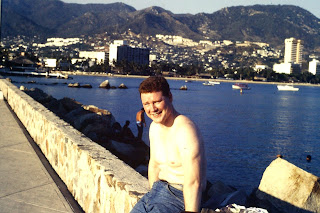
At Acapulco we wound up through a vast sprawl of concrete block houses and apartments before descending into the almost totally enclosed bay. The buildings improved towards the seafront and the multistorey hotels disappeared, Costa del Sol-like, into the distance.

Acapulco de Juárez, commonly called Acapulco, is a city and major seaport in the state of Guerrero on the Pacific coast of Mexico, 380 kilometres (240 miles) south of Mexico City. Acapulco is located on a deep, semi-circular bay and has been a port since the early colonial period of Mexico's history.

The city is one of Mexico's oldest beach resorts, which came into prominence in the 1940s through the 1960s as a getaway for Hollywood stars and millionaires.

We got off the coach and staggered, sweating to an ill-defined bus stop across the road and paid 100 Mexican Pesos each for a ride to the atmospheric tree shaded Zócalo Square with it’s squat white cathedral. This was the Catholic Cathedral, Nuestra Señora de la Soledad, which rests at the end of it's traditional town square, the Zócalo. Despite the age of Acapulco, the church wasn't built until the 1930s and so lacks much of the glorious colonial architecture of Mexican cathedral.

There are some fountains and wonderful large Banyan Trees with immense root systems here in the square where local people gather at night. From here we found the Hotel del Patio who provided a friendly reception and a basic ill-secured double room for 800 Mexican Pesos. The hotel had definitely seen better days and had lost most of it’s custom to the new modern tower block hotels.

We went out, after a much-needed shower, into the heat of the afternoon for a couple of beers. We drank Dos Equis or 2X which is billed as refreshing, crisp, golden, lager style beer brewed in Mexico, before taking a stroll along the harbour front.

We sat in the sun and watched water skiers and parachutists being towed by speed boats in the distance as a few less-affluent locals swam off the rocks.

When we returned to the hotel, we found some sort of fiesta rehearsal underway with much lively Mexican music, but few people in attendance. The hotel manager forecast delights to come from our new neighbours in the next room who he said were big breasted American girls!

I have just begun to stop dripping with sweat, lying here topless under the rotary ceiling fan. The music is blaring outside. The town has a really festive holiday atmosphere. We went for a short stroll through the zócalo where relaxed locals loafed under the banyan trees and ended up in the “El Puerto del Sol” bar. The locals burst into impromptu song as we got steadily drunker and my melancholy mood dispersed.

Some fat and eccentric (or possibly normal) Americans left the pack of tourists and joined in drinking at the bar. It closed at 21:00 hrs. and we paid for our 12 bottles of “Dos Equis” before hammering down a quick meal and returning to the hotel. “Inglaterra esta lejos,” said our waitress (England is a long way away).

Back at the “Hotel del Patio” a ladies Hen Night was in full swing with old biddies and young muchachas salsa-ing with gay abandon. We stood on our first floor balcony overlooking the party in the atrium and the Governor, who seemed to have taken a shine to us, sneaked us up drinks and offered to wake up the American chicas next door for us.

The Governor continued to ply us with “El Presidente” brandy and Coca Cola to make sure that we got well pissed before going to bed. Declan didn’t quite make it to the bog (toilet), giving him some early morning washing of his urine-soaked clothing.

Schiphol

Tuesday 21st June 1988 I got up at 07:00 hrs. and showered before trying to cram all of my gear and my new purchases into my Karrimor ruck...