Friday, May 20, 2022

Rio De Janeiro

Above: Parati in Brazil.

Friday 20th May 1988

I got up fairly early and had breakfast in the hotel dining room which was more like an art gallery. A Siamese cat watched me eat my continental fare. I then went out with my camera to capture the town on film. I walked down to the beach where a few locals were setting out their towels and several horses were grazing on the grass above the white sand.

I took photographs of the solid old churches, the cobbled alleyways, the produce market at the end of the town jetty where fishermen trundled their catch down in wheelbarrows and vegetable products were delivered by horse and cart.

In the town plaza, a big grassy square planted with trees, children played and pop music blared from a stage by the huge main church, the Igreja Matriz Nossa Senhora do Rosário. This is the largest church in Paraty and it takes over a whole block. Its construction started in 1646 and ended only in 1873. The back part of the church was never really finished for two good reasons. They ran out of money, and the whole block started to sink under its heavy weight.

The music and the red bunting strung across the streets were part of some festival. I sat in the plaza and sweated in the hot, humid heat. At 11:00 hrs. I packed up my gear once again and caught the 12:00 hrs. noon bus to Rio de Janeiro. This cost 750 Cruzados.

The scenery was beautiful along the coastal road. There were secluded bays, green wooded hills, blue sea all under a blue sky. We passed a nuclear power station and several road works where the latest labour-saving machinery was in use, not the manpower with picks and shovels of the Andean countries.

The road followed every nook and cranny of the coastline and we were constantly hurtling around often frightening speeds in the luxury coach. We stopped for lunch and I sat out in the sun with my top off for the first time in a long while.

Soon afterwards we reached the shanty towns on the outskirts of Rio de Janeiro. Shanty town or slum in Brazil Rocinha is the largest hill favela in Rio de Janeiro (as well as in Brazil and the second largest slum in Latin America). Although favelas are found in urban areas throughout Brazil, many of the more famous ones exist in Rio.

We hurtled on along a busy dual carriageway into the heart of the city. One of the most picturesque cities in the world, Rio De Janeiro requires no introduction. Known for its gorgeous beaches and free-living lifestyle, this place is an artistic epitome. Visit the iconic Christ the Redeemer landmark, also recognized as one of the Seven Wonders of the World or take solace in famous Ipanema Beach for the lovely mountain views and soothing bossa nova vibes.

Founded in 1565 by the Portuguese, the city was initially the seat of the Captaincy of Rio de Janeiro, a domain of the Portuguese Empire. In 1763, it became the capital of the State of Brazil, a state of the Portuguese Empire. In 1808, when the Portuguese Royal Court moved to Brazil, Rio de Janeiro became the seat of the court of Queen Maria I of Portugal. She subsequently, under the leadership of her son the prince regent João VI of Portugal, raised Brazil to the dignity of a kingdom, within the United Kingdom of Portugal, Brazil, and Algarves.

Rio remained as the capital of the pluricontinental Lusitanian monarchy until 1822, when the War of Brazilian Independence began. This is one of the few instances in history that the capital of a colonizing country officially shifted to a city in one of its colonies. Rio de Janeiro subsequently served as the capital of the independent monarchy, the Empire of Brazil, until 1889, and then the capital of a republican Brazil until 1960 when the capital was transferred to Brasília.

From the Bus Terminal I took a local bus for 28 Cruzados to Copacabana. The city had its fair share of tower blocks, colonial buildings, monuments, plazas and parks, just like many other cities that I had been in.

I glimpsed the sea and saw the familiar Sugarloaf Mountain, a peak that rises 396 meters high and presents a bird’s eye view of Rio de Janeiro from the mouth of Guanabara Bay, and Corcovado , which means "hunchback" in Portuguese, which is a mountain which is a 710-metre (2,329 feet) granite peak located in the Tijuca Forest, a national park. It is known worldwide for the 38-metre (125 feet) statue of Jesus atop its peak, entitled Christ the Redeemer, which was voted as one of the New Seven Wonders of the World.

I could see Christ the Redeemer until we went through a tunnel and emerged in the affluent shopping district of Copacabana, a block inland from Atlantic Avenue and the famous beach. Copacabana begins at Princesa Isabel Avenue and ends at Posto Seis (lifeguard watchtower Six). Beyond Copacabana, there are two small beaches: one, inside Fort Copacabana and the other, right after it: Diabo ("Devil") Beach. Arpoador beach, where surfers go after its perfect waves, comes next, followed by the famous borough of Ipanema.

I got off the bus and consulted my Rio Guide. I had worked out where the International Youth Hostel was when a woman from the Tourist Information Kiosk beckoned me over. Convinced that I must be lost, she spent about fifteen minutes looking for 41 Emilio Berla on her map.

I eventually got away and walked quickly to the Youth Hostel which was located in a small street at the end of Rua Barão de Ipanema. I was allocated a bunk bed in a dormitory for 500 Cruzados per night.

I got some food in McDonalds and went for a walk along the famous seafront. Towering hotels and apartment blocks formed a wall along the full stretch of Copacabana Beach. Tanned, muscular youths did pull ups and dips at the open-air gyms amongst the copses of palm trees on the white sand.

People in elegant evening wear were heading out for the night while at the other end of the spectrum tramps were settling down in cardboard boxes in doorways in the side streets. I had a couple of Brahma Chopp beers in the small bar/café Oriz, one of the many open fronted places where the local working class men drank beer and laughed and joked and argued.

Brahma Chopp is a Lager - Adjunct style beer brewed by Companhia Cervejaria Brahma in São Paulo. “Adjuncts” are anything added to beer that are not one of the four main ingredients. An adjunct beer is simply a beer that has a little (and sometimes a lot) more than your basic ingredients. Most people know beer is made with malt, hops, water and yeast. What many don’t realize is there’s a bunch more stuff that can be added to beer. I called it a night at about 23:30 hrs.

Thursday, May 19, 2022

Parati

Thursday 19th May 1988

I got a liquid breakfast of yoghurt and Pepsi Cola before setting off for the Rodoviário do Tietê Bus Terminal at 09:00 hrs. The Metrô was fairly quiet – I expected it to be packed with commuters. I sat on my rucksack reading my book by Departure Bay 34, until the luxury Scania bus pulled in.

We left promptly at 10:30 hrs. and raced through green forested hills down to the Atlantic coast. We stopped for lunch and I demolished a couple of steak and cheese rolls. The system here in the restaurant was the same as for Monday night. You get a check sheet which the servers mark and you pay the tab on the way out.

The road along the coast was extremely winding amongst green hills covered in tropical forest. Islands dotted the coast looking like packs of sleeping dogs. We arrived at Parati at 16:00 hrs. after passing a multitude of other established and developing beach resorts and holiday centres.

Hotels in Parati were relatively expensive, but after a trek around the scenic holiday town with a group of young touts I checked into the Hotel Solar dos Gerânios on the Praça da Matriz. It cost me 1,500 Cruzados but I was hot, tired and sweaty and not in the mood to explore further. I showered and washed some clothes in my nice dark wood and white walled room.

The town had a lot of atmosphere and a holiday air. There were a lot of Brasilians in shorts and T-shirts on the streets and a holiday fiesta was underway. The buildings were solid old Portuguese colonial and the streets were uneven with huge cobble stones so walking along them made you feel as if you were drunk! A scroll bears the inscription “1660 Paraty 1844” These are the dates that Paraty initially achieved status as a town and then later city status.

The village of Paraty was founded in 1597. It was established formally as a town by Portuguese colonists in 1667, in a region populated by the Guaianás Indians. The Guaianás people who lived where the city now stands called the entire area “Paraty”. In the Tupi language “Paraty” means “river of fish”. Even today the Brazilian Mullet (Mugil brasiliensis) still come back to spawn in the rivers that spill into the Bay of Paraty. When the region was colonized by the Portuguese, they adopted the Guaianás name for their new town.

Like Venice in Italy the quaintness and uniqueness had been exploited to the full. Every building was an expensive tourist gewgaw shop or a fancy restaurant. I got a meal and a Kaiser beer at a pizza place. A middle-aged man with a young dolly-bird pulled up in a fancy car and sat at a table by their car with it’s stereo system blaring out loud music.

I walked back through the main square where there were a lot of stalls and kiddies everywhere were lobbing firecrackers about. The big cathedral had a capacity crowd for evening prayer. I resisted the temptation to join them as I was tired and retired early to bed.

Wednesday, May 18, 2022

Praça da República

Wednesday 18th May 1988

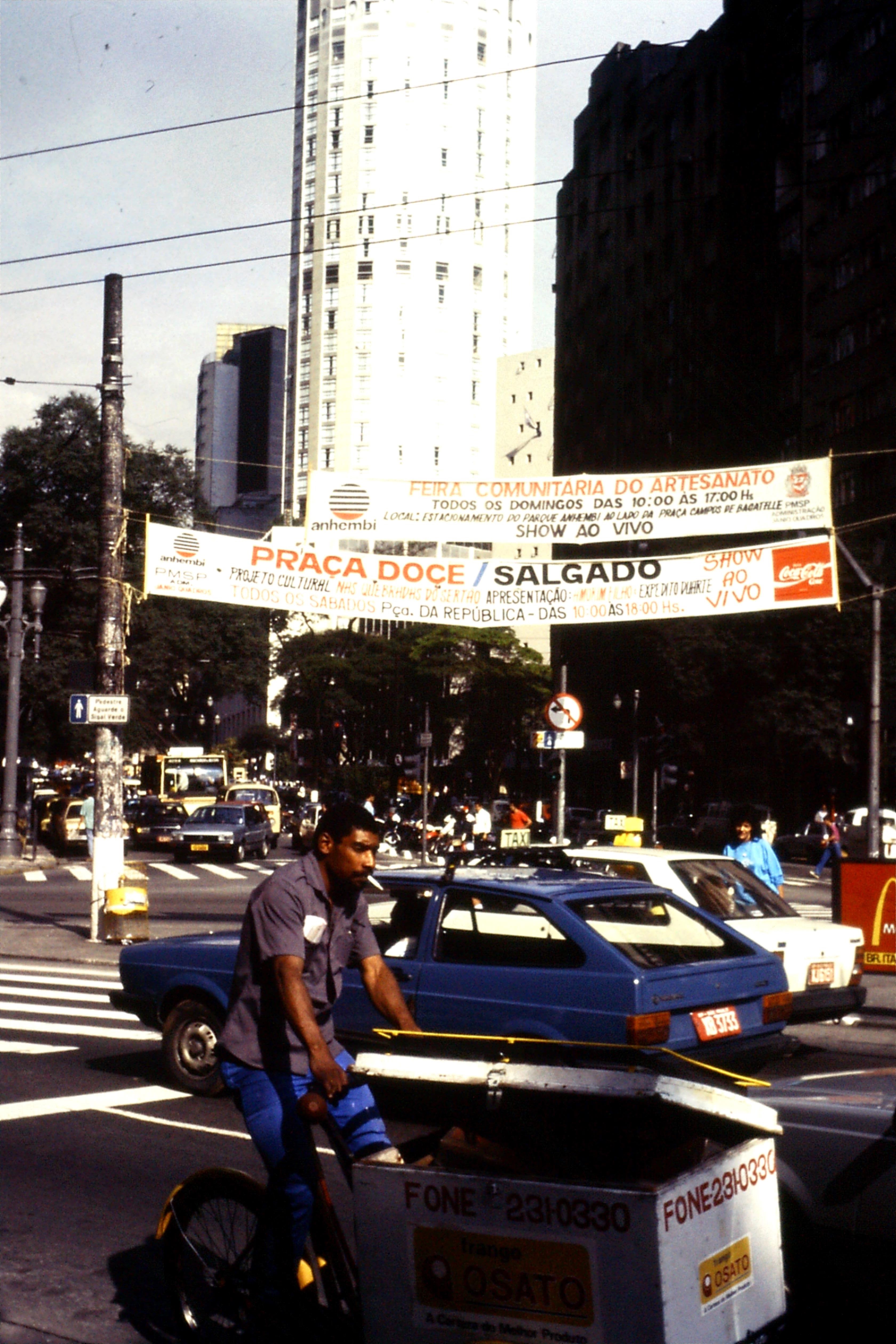
My first objective for the day was to find the Tourist Office. I found an office at Avenida São Luís 115, just along from the busy Praça da República (Portuguese: Square of the Republic). This is a park and public square in the República neighborhood of São Paulo, Brazil.

The park covers several city blocks between Rua Pedro Américo, Rua Vinte e Quatro de Maio, Avenida Ipiranga, and Avenida São João in the historic centre of the city. Praça da República had many names before 1889, including Largo dos Curros, Largo da Palha, Praça das Milícias, Largo Sete de Abril, and Praça 15 de Novembro.

I was the only customer and the kindly lady on duty spent a lot of time going through brochures and making suggestions. Unfortunately, most tours and events seemed to take place at the weekend. I eventually got away with a sheaf of leaflets and a number to ring if I had any problems.

I then found a second-hand book shop setup in a caravan on the pavement. Here I got a couple of good books for less than $2US dollars. I had brunch in McDonalds and returned to the hotel. I spent an hour or so marking my route through Latin America on my large wall map and planning the route ahead.

That decided I went out to change money at the Boreal Turismo Office at Rua Dom José de Barros 326. Today I got 202 Cruzados per $US dollar for a travellers cheque. I then took the Metro to the Rodoviário do Tietê Bus Terminal, going on both Metro lines from República. I bought a bus ticket to Parati for tomorrow at 10:30 hrs. for 637 Cruzados.

Paraty (or Parati) is a preserved Portuguese colonial (1500–1822) and Brazilian Imperial (1822–1889) municipality. It is located on the Costa Verde (Green Coast), a lush green corridor that runs along the coastline of the state of Rio de Janeiro, in Brazil.

Paraty has become a tourist destination, known for its historic town centre and the coast and mountains in the region. The historic centre of the city, as well as four areas of the Atlantic Forest, were inscribed on UNESCO World Heritage List in 2019 under the title "Paraty and Ilha Grande".

It was raining outside and a helicopter hovering over the tower blocks attracted interested glances from the scurrying crowds. Policewomen in groups of three patrolled the efficient Bus Depot. I got off the Metro at São Bento on the way back and walked over the colourful viaduct, now a pedestrian way.

Santa Ifigenia Viaduct, São Paulo Viaduto Santa Ifigênia was opened in 1913 and links Largo de Sao Bento with Santa Ifigenia. Although never proven, it was once rumoured to have been built by the famous Gustav Eiffel, creator of the Eiffel Tower. The viaduct was restored in 1978 and in 1982 was painted with the colours of the rainbow.

Back in my room I wrote some postcards which I posted before going to the flicks (cinema) at 18:00 hrs. to see “Extreme Prejudice”, which is a 1987 American Neo-Western action thriller film, effectively an updated Spaghetti Western, starring Nick Nolte. A Texas Ranger and a ruthless narcotics kingpin - they were childhood friends, now they are adversaries.

I bought supper and some wine in a supermarket on the way back to relax in my room. I popped out to ditch some rubbish at 22:00 hrs. and pretty, scantily-clad girls were just taking up their strategic positions for the night’s work ahead.

I started reading “Firestarter” before falling asleep. “Firestarter” is a science fiction-horror thriller novel by Stephen King, first published in September 1980. Andy and Charlene "Charlie" McGee are a father/daughter pair on the run from a government agency known as The Shop. During his college years, Andy had participated in a Shop experiment dealing with "Lot 6", a drug with hallucinogenic effects similar to LSD.

The drug gave his future wife, Victoria Tomlinson, minor telekinetic abilities and him a telepathic form of mind control he refers to as "the push". They both also developed telepathic abilities. Andy's and Vicky's powers were physiologically limited; in his case, overuse of the push gives him crippling migraine headaches and minute brain haemorrhages, but their daughter Charlie developed frighteningly strong pyrokinetic ability.

Tuesday, May 17, 2022

São Paulo

Tuesday 17th May 1988

We arrived at 08:30 hrs. on a gloomy rainy morning at São Paulo Bus Terminal, which was more like an airport. I then commenced a wild goose chase by Metro and bus across the Ibirapuera District in search of the International Youth Hostel. I found the huge stadium complex which once housed the Youth Hostel but was told that the Youth Hostel no longer existed.

I lugged my baggage back passed the huge legislative assembly building and caught a bus into the city centre. Somewhere in the hustle and bustle of people around Luz Metro Station I met Darcy, a Brazilian woman, who took me to the Rua Santa Ifigênia where I got a room in the Hotel Trinidade for 500 Cruzados.

Rua Santa Efigênia is an important road located in the district of República, downtown São Paulo, which over the years became known for the large number of stores that specialized in the sale of electronic items. Darcy gave me her card and told me to ring her later. She also warned me that this was a dodgy area at night.

I got shot of my bags and went for a walk around. I found the Post Office on Avenida São João and posted some cards. I also bought a Portuguese phrase book as my knowledge of the language is practically nil.

São Paulo is a busy, modern, American-style megacity with towering skyscrapers. Umbrellas moved with the mob on the streets as the rain fell. Pavement stalls sold pornographic books of every description. I avoided the many prostitutes and bought a copy of “Men Only” magazine, a Paul Raymond publication, for light reading!

The Metro is very modern and efficient and only costs 35 Cruzados per trip. I picked up some goodies from the supermarket and went back to my room at 18:00 hrs. to catch up on my diary writing.

At 19:30 hrs. I went out to see the city at night. Most of the stand-up or bar stool at the counter bars and cafés were doing a good trade. There were a lot of shops selling books, clothes and several selling guns and all your Rambo gear.

Poor people sat in some of the doorways wrapped in blankets and barefoot tramps rummaged through the rubbish bags. I followed pedestrian precincts between the bright lights and tall buildings. At 20:30 I grabbed a quick Antarctica beer, a Euro Pale Lager style beer made in São Paulo, SP by Ambev. 4.9% ABV. I then went to the cinema to see “Raw Deal”, a run of the mill “cop busts gangsters” film.

Raw Deal is a 1986 American action film directed by John Irvin, from a story of Sergio Leone's screenwriters Luciano Vincenzoni and Sergio Donati, and starring Arnold Schwarzenegger, Kathryn Harrold, Darren McGavin and Sam Wanamaker. The film tells the story of an elderly and embittered high-ranking FBI chief, Harry Shannon, who wants to get revenge against a Mafia organization and sends a former FBI agent and now small-town sheriff Mark Kaminski to destroy the organization from the inside.

Back in my room I browsed my Portuguese phrase book before going to sleep.

Sunday, May 15, 2022

Itaipú Hydroelectric Dam

Monday 16th May 1988

We got up, showered and had the hotel breakfast which turned out to be more substantial than we expected. The coffee was strong and sweet. Our first intention was to change money, but we met Edgar, the resident German who Steve and Hugo had met yesterday and he told us to wait until after 10:00 hrs. when the rate was revised after the weekend.

We decided to visit the Itaipú Hydroelectric Dam in the meantime and took a bus to the Visitors Reception Centre for our free film and tour. The film was very professional and informative, following the project through it’s stages of construction to the present day.

It is a joint venture between Paraguay and Brazil on the Paraná River. Paraguay was taken into the partnership partly to assuage Paraguayan grievances following the war against the triple alliance when Paraguay lost a lot of land to Brasil.

The Paraguayan War, also known as the War of the Triple Alliance, was a South American war that lasted from 1864 to 1870. This war was fought between Paraguay and the Triple Alliance of Argentina, the Empire of Brazil, and Uruguay. It was the deadliest and bloodiest inter-state war in Latin American history.

We went for a coach ride across the top of the colossal dam with views over the huge man-made lake behind it. The most spectacular sight is the three overspill channels which regulate the level of water in the lake.

Vast volumes of water hurtle down these ramps and explode into blossoming spray at the bottom where “ski jumps” slow down the flow to avoid excessive erosion of the riverbed. Disappointingly we were not shown inside the dam where the downpipes, turbines and generators are capable of generating 12,600,000 kW of electricity.

The workers are all catered for and the surrounding area is developing rapidly. In all a good public relations exercise which was very interesting. We got the bus back into town and I spent most of the journey with buttocks clenched and sweating while trying to fight a bout of diarrhoea. I struggled off the bus and into the bog (toilet), not a moment too soon!

At the Long Distance Bus Terminal we met Edgar again and he changed travellers cheques for us at 195 Cruzados to the $US dollar. The Swiss boys took Edgar’s advice to head for Campo Grande – Corumbá - Asunción which is the capital and the largest city of Paraguay in South America.

However, I decided to head north via the coast and bought a 2,200 Cruzados ticket to São Paulo which is a city in the Southeast Region of Brazil. Listed by the GaWC as an alpha global city, the municipality of São Paulo is the most populous city proper in Brazil, the Americas, the Western Hemisphere and the Southern Hemisphere, as well as the world's 4th largest city proper by population.

We had a final meal together in another “eat as much as you can for a fixed price” establishment while Edgar and the boys rabbited on in German. I said goodbye and caught my Pluma Bus at 15:30 hrs.

Pluma Bus Company works in Southeast and South regions of Brazil, with destinations to the states of São Paulo, Rio de Janeiro, Minas Gerais, Santa Catarina, Paraná and Rio Grande do Sul. The internationals destinations are Chile, Argentina and Paraguay.

Opened in 1966, the company started working with about 170 employees and 34 buses in its fleet. Its headquarter is in Curitiba, which helped the area growth. Years later, still booming, in 1971, the company started its first international line.

There were a dubious looking crowd of passengers on the bus and customs officials obviously thought likewise because they had everyone off the bus for a thorough search when we reached the checkpoint at 16:30 hrs. An hour later we got away.

At the evening food stop I had a beer and talked to Alex from Rio de Janeiro, who had lost all of the duty-free goods that he was smuggling back from Paraguay. The confiscation of luxury goods left him $1,000 US dollars out of pocket he claimed. “If it had been a bus to Rio de Janeiro, they wouldn't have stopped it”, he said. “These São Paulistanos are a dodgy bunch”! Apparently, two guns were also confiscated.

Fog obscured green cultivated fields and rain poured down, leaking into the coach in a few places. Spectacular sheet lighting lit up the cloudy sky like a continuous series of explosions. Alex talked to me in English until the São Paulo versus Rio de Janeiro rivalry barracking and joking got too much and he returned to his place. I dozed most of the night in my reclining seat.

Saturday, May 14, 2022

Foz do Iguaçu

Sunday 15th May 1988

I crammed down a couple of corned beef sandwiches as we packed up our gear. At the Bus Terminal we took the bus to Brazil for ₳5 Australes. Buses left every twenty minutes from 07:00 hrs. We had to get off the bus at Argentine Customs to get our exit stamp, take the next bus to Brazilian Immigration, which was very relaxed, for our entry stamp, and then take a third bus into town.

A young hotel tout took us to a few expensive hotels before we took a triple room at the San Remo Hotel for 1,500 Cruzados. The cruzado was the currency of Brazil from 1986 to 1989. It replaced the second cruzeiro (at first called the "cruzeiro novo") in 1986, at a rate of 1 cruzado = 1000 cruzeiros (novos) and was replaced in 1989 by the cruzado novo at a rate of 1000 cruzados = 1 cruzado novo. This currency was subdivided in 100 centavos and it had the symbol and the ISO 4217 code BRC.

Above: Hotel San Remo.

Everything in the town of Foz do Iguaçu was closed but luckily Hugo had a load of Brazilian money to pay for us today. We took a bus to the falls which cost 50 Cruzados plus 160 Cruzados for entry to the park. The Brazilian side offers a fine, panoramic view of the whole range of waterfalls.

We walked along the narrow path adding to our already significant collection of waterfall photographs. Several brown furry animals with long striped tails (coatis) foraged by the path, another target for photographers.

The final catwalk led through wind-blown spray to the Devil’s Throat which hurtled, roared and tumbled into the mist below. Solid looking rainbows spanned the river between the cliffs.

Above: Steve and Hugo at the Foz do Iguaçu in Brazil.

We took a bus back to town and I went back to the hotel for a kip (sleep) while the Swiss boys tried in vain to get a bus to the huge Itaipú Hydroelectric Dam Project. The Itaipu Dam (Portuguese: Barragem de Itaipu, Spanish: Represa de Itaipú) is a hydroelectric dam on the Paraná River located on the border between Brazil and Paraguay.

They got back at 17:00 hrs. after a long chat with a German migrant in the town centre. We lay about and wrote while listening to Paraguayan Radio Stroessner on the transistor radio. At 20:00 hrs. we went out to get something to eat.

We went to a churrascaria on Avenida Brasil which offered as much as you could eat for about $4 US dollars. We took a table in a vast wooden hall while a local trio of musicians played live music. It was set up as a serve-yourself carvery and we got stuck in with a vengeance.

Plates of beef, chicken, pork, exotic salad and rice was swept down our gullets with red wine. A night of overindulgence that had us tottering back to the hotel to lay on our beds with stomachs gurgling and struggling to digest the unexpected excessive volume of food and drink.

Iguazú Falls

Saturday 14th May 1988

We laid in bed for a bit and got the 10:00 hrs. bus to the Cataratas. This cost ₳13 Australes for a return ticket and ₳7 Australes for entrance to the national park. We met Hugo, another Swiss guy, on the bus. The bus stopped outside the exclusive hotel by the falls and we got our first sight of the waterfalls from what looked like a lighthouse on it’s plush lawns.

Iguazú Falls or Iguaçu Falls (Guarani: Chororõ Yguasu, Spanish: Cataratas del Iguazú; Portuguese: Cataratas do Iguaçu) are waterfalls of the Iguazu River on the border of the Argentine province of Misiones and the Brazilian state of Paraná.

Together, they make up the largest waterfall system in the world. The falls divide the river into the upper and lower Iguazu. The Iguazu River rises near the heart of the city of Curitiba. For most of its course, the river flows through Brazil; however, most of the falls are on the Argentine side. Below its confluence with the San Antonio River, the Iguazu River forms the border between Argentina and Brazil.

The name Iguazú comes from the Guarani or Tupi words "y", meaning "water", and "ûasú ", meaning "big". Legend has it that a deity planned to marry a beautiful woman named Naipí, who fled with her mortal lover Tarobá in a canoe. In a rage, the deity sliced the river, creating the waterfalls and condemning the lovers to an eternal fall. The first European to record the existence of the falls was the Spanish Conquistador Álvar Núñez Cabeza de Vaca in 1541.

We had coffee by the two sisters, two waterfalls which on their own would attract tourists in Europe but here were only a minor side show. We got an overall view of the massive line of waterfalls which spanned the Iguazú river. Rainbows appeared and disappeared in the spray around the bottom and our cameras worked overtime.

The staircase character of the falls consists of a two-step waterfall formed by three layers of basalt. The steps are 35 and 40 metres (115 and 131 feet) in height. The columnar basalt rock sequences are part of the 1,000-metre-thick (3,300 ft) Serra Geral Formation within the Paleozoic-Mesozoic Paraná Basin. The tops of these sequences are characterized by 8–10 metres (26–33 feet) of highly resistant vesicular basalt and the contact between these layers controls the shape of the falls. Headwater erosion rates are estimated at 1.4–2.1 cm/year (0.55–0.83 inches/year).

Numerous islands along the 2.7-kilometre-long (1.7 mi) edge divide the falls into many separate waterfalls and cataracts, varying between 60 and 82 metres (197 and 269 feet) high. The number of these smaller waterfalls fluctuates from 150 to 300, depending on the water level. About half of the river's flow falls into a long and narrow chasm called the Devil's Throat (Garganta del Diablo in Spanish or Garganta do Diabo in Portuguese).

The Devil's Throat canyon is 80–90 metres (260–300 feet) wide and 70–80 m (230–260 feet) deep. Left of this canyon, another part of the river forms 160–200 individual falls, which merge into a single front during flood stage. The largest falls are named San Martín, Adam and Eva, Penoni, and Bergano.

About 900 metres (2,950 feet) of the 2.7 kilometres (1.7 miles) length does not have water flowing over it. The water of the lower Iguazu collects in a canyon that drains into the Paraná River, a short distance downstream from the Itaipu Dam. The junction of the water flows marks the border between Brazil, Argentina, and Paraguay. Some points in the cities of Foz do Iguaçu, Brazil, Puerto Iguazú, Argentina, and Ciudad del Este, Paraguay, have access to the Iguazu River, where the borders of all three nations may be seen, a popular tourist attraction for visitors to the three cities.

We took a boat across to the beach on San Martin Island for ₳9 Australes and ascended to get closer to the roaring falls on the spray showered south side. We also got a distant view of the turbulent horseshoe of the Devil’s Throat (Garganta del Diablo).

Next, we walked along walkways along the top of the falls disturbing basking lizards and being swooped upon by multicoloured butterflies which would settle on your hand. A wealth of photographs later we stopped for a liquid lunch of white wine and then took the bus to Puerto Canoas (inclusive ticket).

From here a walkway led out to the Devil’s Throat. Spray obscured the bottom of this U-shaped turmoil of churning brown water. An awesome, powerful, roaring cascade. Cameras clicked and groups posed all around us. Sightseeing helicopters chuntered about above us.

We returned to the town and Hugo booked into Residential Arco Iris where we were staying. I was starving so I nipped into town and returned with a tin of corned beef (only ₳3.5 Australes) and a loaf of bread for a snack.

We ate dinner later, a handsome steak dinner with red wine in a nice parrilla. A parrilla is a simple iron grill barbecue and they’re everywhere. Now that spring has sprung in Argentina, you can literally smell the chargrilled chorizo smoke rising from the terraces, whether from local restaurants or home-cooked asados.

After a hearty meal we drank coffee and watched Tom and Jerry cartoons on the television. I stopped for a Pepsi Cola on the way back home, at a kiosk where the owner was fiddling with a dodgy radio to try and get a sensible volume of sound between really loud and distorted or off.

Schiphol

Tuesday 21st June 1988 I got up at 07:00 hrs. and showered before trying to cram all of my gear and my new purchases into my Karrimor ruck...